

Most workers on Indonesian construction sites can correctly name the pieces of personal protective equipment they are required to wear. Helmet. Vest. Boots. Full body harness. Gloves where applicable. Eye and hearing protection in specific work areas. The naming part is fine. The problem is rarely vocabulary.
The problem is what happens before the work day actually starts. The harness gets handed over by the storekeeper without inspection. The worker puts it on without adjusting the straps properly. The buckle on the chest strap is loose. The leg straps are twisted. The D-ring on the back is positioned too low. The lanyard isn’t paired with a shock absorber, or it is paired but the shock pack has visible damage no one bothered to check. Every step in this sequence is small. The cumulative effect is a worker who is technically wearing fall protection that wouldn’t actually arrest a fall correctly.
This article looks at how VR working at height training drills the PPE selection and inspection sequence — the equipment room phase before the worker reaches the work position — and how it fits within the regulatory frame set by Permenaker No. 8 Tahun 2010 (Alat Pelindung Diri) and Permenaker No. 9 Tahun 2016 (K3 dalam Pekerjaan pada Ketinggian).
What Permenaker 8/2010 actually requires
The regulation sets the baseline obligations for personal protective equipment in Indonesian workplaces. The employer is required to provide PPE appropriate to the hazards present, in sufficient quantity, of acceptable quality, with documentation of issuance, and with training on correct use.
The worker is required to use the provided PPE during work that warrants it, to report damaged or worn equipment, and to participate in training when offered.
For work at height specifically, Permenaker 9/2016 adds the technical layer. The full body harness — not a body belt — is the required configuration for fall arrest. The lanyard must include a shock-absorbing component capable of limiting fall arrest forces. The connectors must be rated for the application. The harness must fit the worker and be inspected before use.
What the regulations specify is the equipment standard and the inspection obligation. What they don’t specify — and what most workplace programs do not actually drill — is the cognitive habit of going through that inspection every single time the equipment comes off the rack.
Why the PPE inspection step is consistently skipped
Three reasons show up across most construction sites.
The first is familiarity. A worker who has put on the same model of harness three hundred times stops looking at it. The visual inspection becomes automatic, which sounds good, except that automatic inspection misses defects. The strap that has frayed at the buckle attachment. The stitching that has separated near the D-ring. The shock pack that has been deployed previously and is no longer rated. These defects are visible to someone who is looking; they are invisible to someone who is going through the motions.
The second is time pressure. The morning toolbox briefing runs late. The supervisor wants the crew on the deck before the formwork pour starts. The PPE issuance window collapses from fifteen minutes to three. The worker grabs the harness, puts it on, and runs.
The third is the lack of consequence in classroom training. PPE inspection is taught in classroom format as a checklist. Workers can recite the checklist. They cannot reliably perform it under pressure because the classroom version has no decision points — every harness in the training session is a clean training harness. Real harnesses on a real site come with varying levels of wear, varying levels of cleanliness, varying levels of fit.
The VR equipment room phase addresses these gaps by making the inspection a decision rather than a procedure.
What the equipment room scenario actually drills
The scenario takes place in a simulated PPE storage area before the work begins. The trainee sees the equipment on the rack — harnesses (commonly modeled in different sizes and colors to match what the contractor actually issues), helmets, safety vests, boots, gloves, and any specific equipment required for the work (lanyards, shock packs, energy absorbers, mobile fall arresters).
The trainee selects each piece. The selection itself is a decision point — multiple options are present, and some of them are wrong. Different harness sizes, where the trainee has to recognize fit. Harnesses with visible damage where the trainee has to recognize and reject them. Helmets without a chin strap. Vests without the required reflective banding. Boots without steel toe.
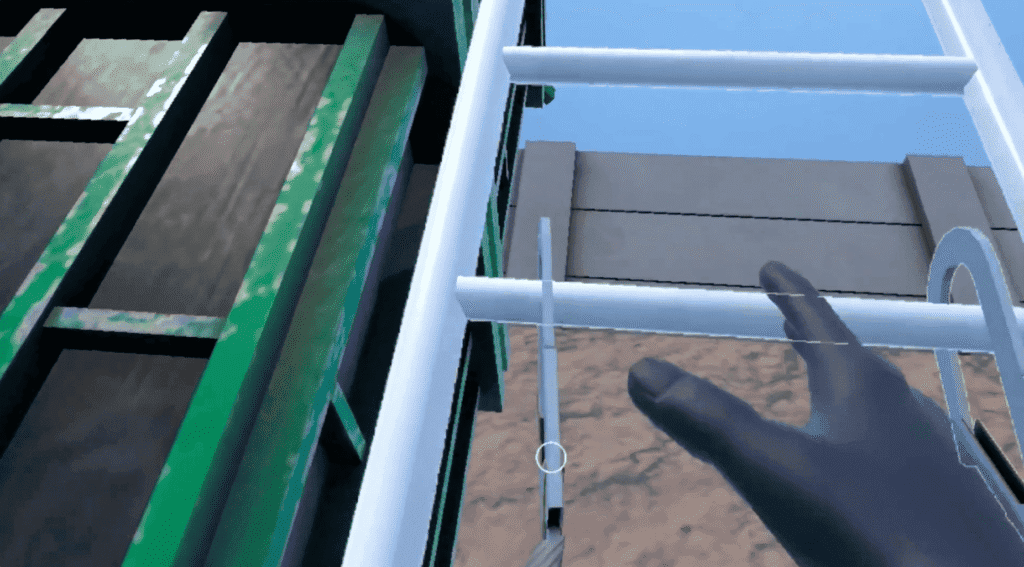
For each selected item, the scenario presents the inspection step. The trainee has to look at the equipment — visually rotate it in the VR environment — and identify any defects. The harness with a frayed strap. The lanyard with a deployed shock pack. The helmet with a crack. The buckle that doesn’t latch properly. Choosing to use a defective item progresses the scenario into a failure mode that gets drilled in the debrief.
For the harness specifically, the scenario covers the donning sequence. The shoulders go on first. The chest strap goes across the sternum at the correct height. The leg straps wrap correctly without twisting. The D-ring on the back is positioned between the shoulder blades. The waist belt, where present, is snug but not restrictive. The trainee has to perform the sequence; the scenario tracks whether it was done correctly.
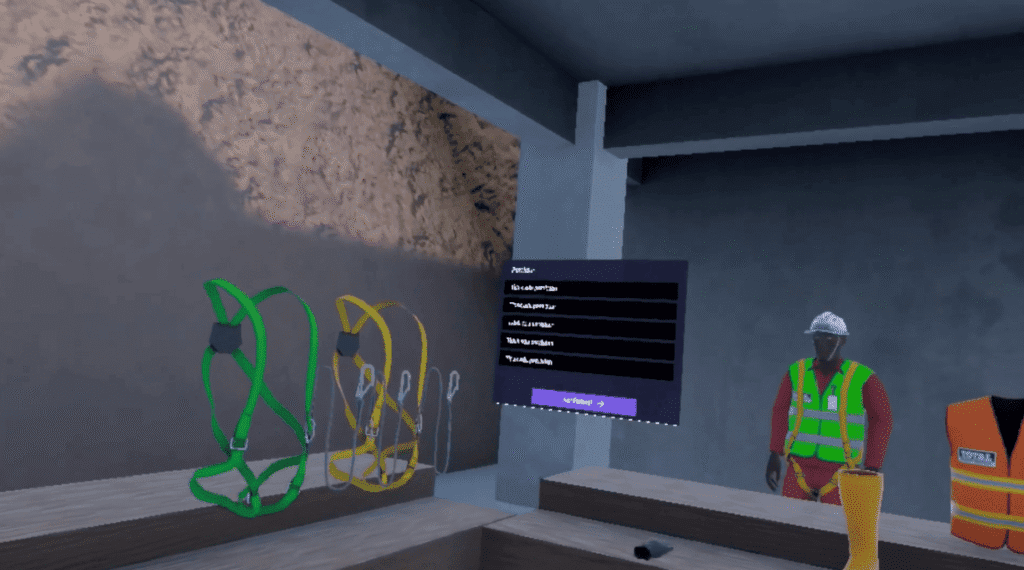
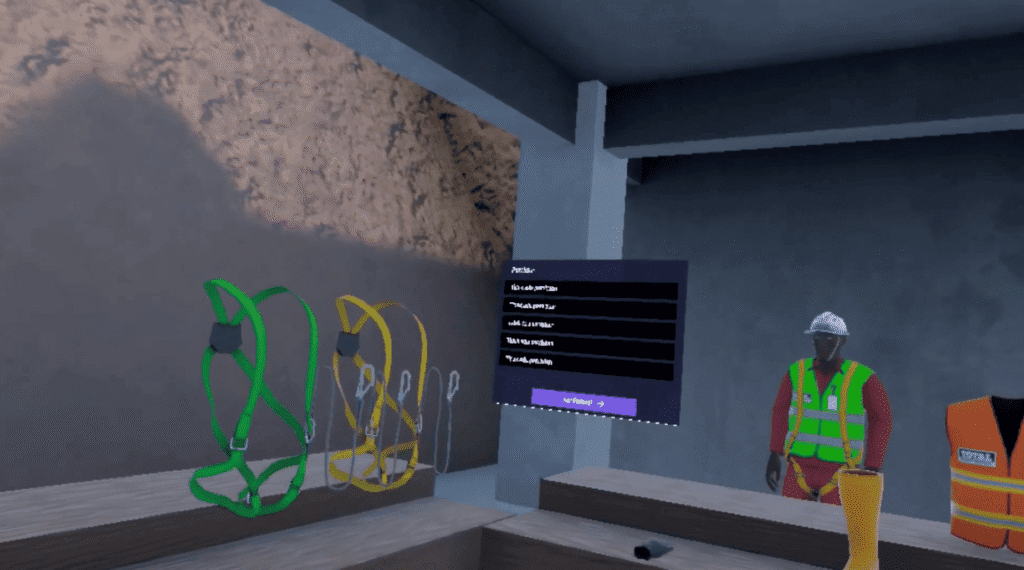
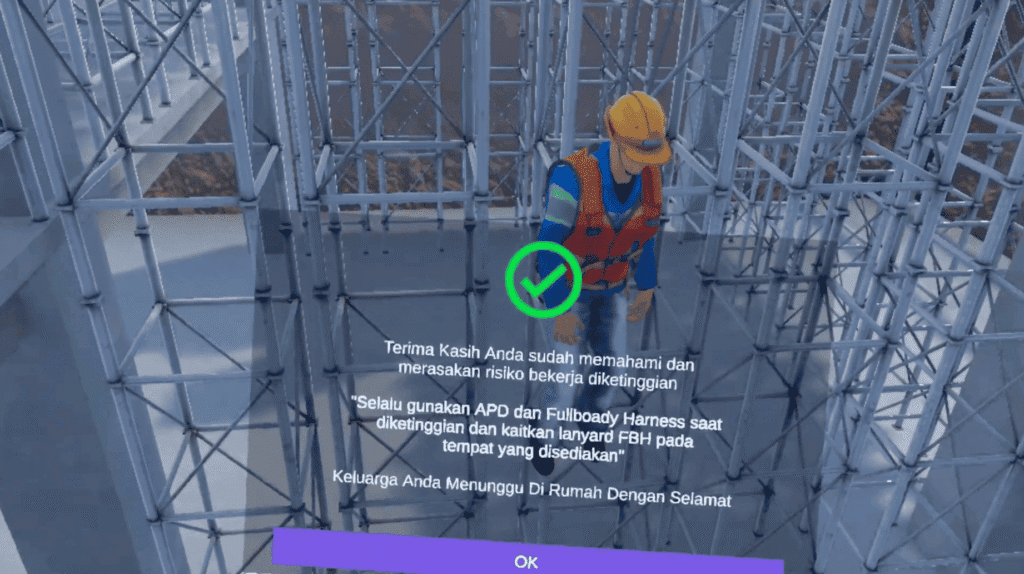
Where the contractor has a specific issued PPE configuration — for example, the green and yellow harnesses visible in the VGLANT scenario built for PT Total Bangun Persada — the simulation matches that configuration. Workers see the same equipment they will see on site, which makes the cognitive transfer cleaner.
What the data from this phase provides
Each session generates measurable output. For the PPE selection phase, the data points that matter:
Selection accuracy. Whether the trainee picked the right equipment for the work or selected an inappropriate alternative.
Defect recognition rate. Whether the trainee identified the damaged items planted in the scenario or attempted to use them.
Donning sequence compliance. Whether the harness was put on correctly, with straps in correct orientation and buckles latched.
Time to ready state. The interval between entering the equipment room and being correctly equipped for the work. This metric is useful as a baseline; rapid times suggest familiarity, but they should not come at the cost of accuracy.
For an HSE team running a contractor workforce of several hundred workers, this data lets them identify which workers consistently inspect their equipment properly, which workers skip steps, and where targeted refresher would have the most impact.
Where physical training still belongs
Worth being direct about the limits.
The physical sensation of harness fit cannot be fully replicated in VR. The way the leg straps actually feel against the worker’s body, the weight distribution across the shoulders, the tightness of the chest strap — these need physical practice with real equipment. VR can drill the recognition and the sequence; the physical fit needs the actual harness.
Live inspection of real equipment, with actual frayed straps and actual deployed shock packs, is still valuable. The tactile differences between worn and serviceable equipment register physically in a way that visual simulation cannot fully capture.
Initial certification for work at height under Permenaker 9/2016 — particularly for Tenaga Kerja Bangunan Tinggi 1 and 2 — continues to require accredited training through BNSP-recognized providers. VR is not an accreditation path.
Site-specific PPE issuance procedures and the contractor’s own inspection protocols remain part of the operational rollout. Every contractor has its own colour coding, its own inspection schedule, its own retirement criteria. VR scenarios are generic by design with respect to these specifics; site procedures remain separate.
VR fits between these. More frequent than the annual K3 refresher. Wider variation in defect scenarios than physical training can practically arrange. Better data on individual inspection discipline than supervisor observation can capture across a large workforce.
VGLANT PPE selection modules
VGLANT, built by PT Virtu Digital Kusuma, includes PPE selection scenarios as part of its working at height training catalog. The equipment room phase covers harness selection and fit, helmet selection and chin strap inspection, vest selection with reflective banding check, footwear appropriate to the work, and lanyard and shock pack inspection.
The scenario can be customized to match the contractor’s actual issued equipment — the specific harness model, the colour coding the contractor uses for inspection status, the issued helmet style, the vest configuration. For PT Total Bangun Persada, the green and yellow harnesses, the branded vest, and the helmet style are modeled to match what workers see in the actual equipment room.
The protocols align with Permenaker 8/2010 for APD, Permenaker 9/2016 for work at height, and reference applicable SNI standards. Hardware runs on standalone Meta Quest headsets in the IDR 7 to 25 million range per unit. Content is licensed annually, per-seat or per-site.
For pilot scoping or customization scoped to a specific contractor’s PPE program, contact enquiry@vglant.com or +62 818 0755 5538.