

A polished demo is the easiest part of buying VR safety training. Any vendor can put on a five-minute show that looks impressive in a meeting room. The hard part — the part that determines whether the investment actually reduces risk a year from now — is everything the demo doesn’t show. Choosing the best VR training partner is a procurement decision, and it deserves the same scrutiny you’d give any other supplier of safety-critical equipment.
Here’s a checklist HSE managers in Indonesia can run through before signing anything.
1. Does the content map to Indonesian regulation?
This is the first filter, and it eliminates a surprising number of options. A platform built around OSHA standards and American fire codes isn’t built for your compliance reality. Ask directly whether the content aligns with the frameworks your audit actually uses — Permenaker 15/2008 for P3K, Permenaker 9/2016 for work at height, Kepmenaker 186/1999 for fire response, and the broader SMK3 structure under PP 50/2012. A vendor who can’t answer this clearly is selling you a foreign product with a local sales pitch.
2. Is the fire and physics behavior real, or is it animation?
There’s a meaningful difference between a scripted animation that plays the same way every time and a simulation where fire spreads according to conditions and smoke behaves like smoke. The first teaches a sequence. The second teaches judgment. Ask how the scenarios respond when a worker does the wrong thing — if the answer is “the animation just continues,” you’re looking at an interactive video, not a simulation.
3. Does it actually track performance?
If the system can’t tell you how a worker performed — response time, accuracy, where they hesitated — then you’ve bought an expensive way to deliver the same uncertainty you had before. Performance tracking isn’t a luxury feature. It’s the entire reason VR beats a video. Insist on seeing the data output before you commit.
4. Can it run where your workers actually are?
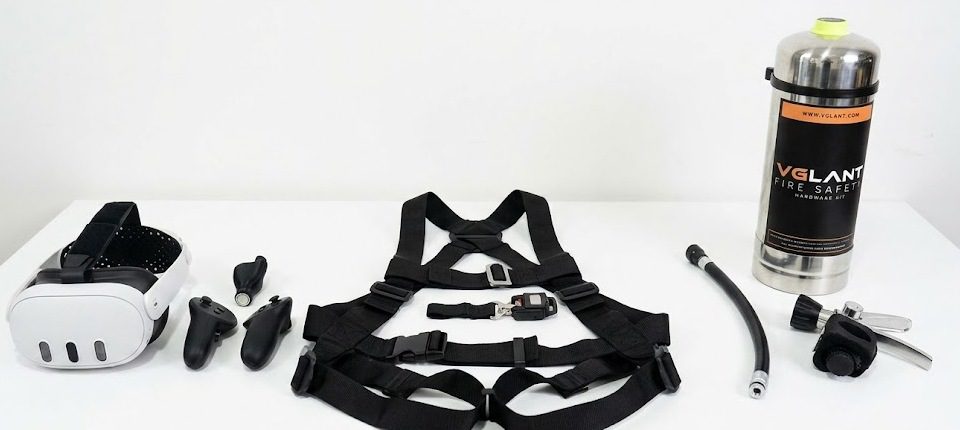
Indonesian industrial sites aren’t always near a city, and they don’t always have reliable connectivity. A platform that depends on a powerful PC and a constant internet connection is a platform that won’t deploy to a remote plant. Standalone headsets and a self-contained, portable setup — the kind that travels in a hardened case to a site and works on arrival — matter enormously for multi-site or remote operations.
5. Will they customize, or only sell off-the-shelf?
Standard modules are fine for universal skills. But your highest risks are usually site-specific, and a vendor who can only sell you a fixed catalog can’t address them. Ask whether they can rebuild your environment, your layout, and your specific hazards — and what that costs. The answer separates a software reseller from an actual training partner.
6. What happens after the sale?
The headset arriving is the start of the work, not the end. The real question is who manages the program once the equipment is on site. Who trains your trainers? Who handles a device that won’t boot? Who updates content when a regulation changes? A vendor whose involvement ends at delivery is leaving you to run a technical program alone. Implementation support is often the difference between a program that sticks and a set of headsets gathering dust in a cupboard.
7. Is the company local enough to support you?
Time zones and travel matter. A provider based in Indonesia — one that understands the local industrial landscape and can reach your site — will support you in ways a distant overseas vendor structurally can’t. Local presence isn’t a nice-to-have when a problem needs solving the same week.
8. Can they show real deployments, not just a demo?
Ask who else uses the platform and in what conditions. A vendor with real clients in industries like yours — manufacturing, oil and gas, mining, government — has solved problems a newer entrant hasn’t met yet. References and case histories tell you more than any sales deck.
9. Does the pricing reflect total cost, or just the headline?
The sticker price is rarely the real number. Factor in content customization, ongoing support, hardware maintenance, and updates over the life of the program. A low upfront price with no support model can cost more over two years than a higher price that includes everything. Compare total cost of ownership, not the first invoice.
The pattern behind the checklist
Run those nine questions and a pattern emerges. The weak options are strong on the demo and vague on everything that happens afterward — compliance fit, real tracking, deployment, support. The strong ones are the reverse: less interested in dazzling you in the meeting room, more interested in whether the program will still be working, and reducing risk, a year later.
That’s the right frame for the whole decision. You’re not buying a headset. You’re buying a safety outcome that has to hold up under audit, deploy to your actual sites, and survive long after the demo is forgotten. Judge the vendor on that, and the best VR training partner becomes a lot easier to identify.