

VR safety training for fire response replaces a portion of conventional fire drills with simulated scenarios run through a head-mounted display. Trainees experience fire emergencies in a controlled environment, practice the same procedures they’d use in real life, and generate performance data each session. This piece covers how it works, what it can drill, and where it fits in Indonesian K3 fire safety programs.
How VR fire safety training works
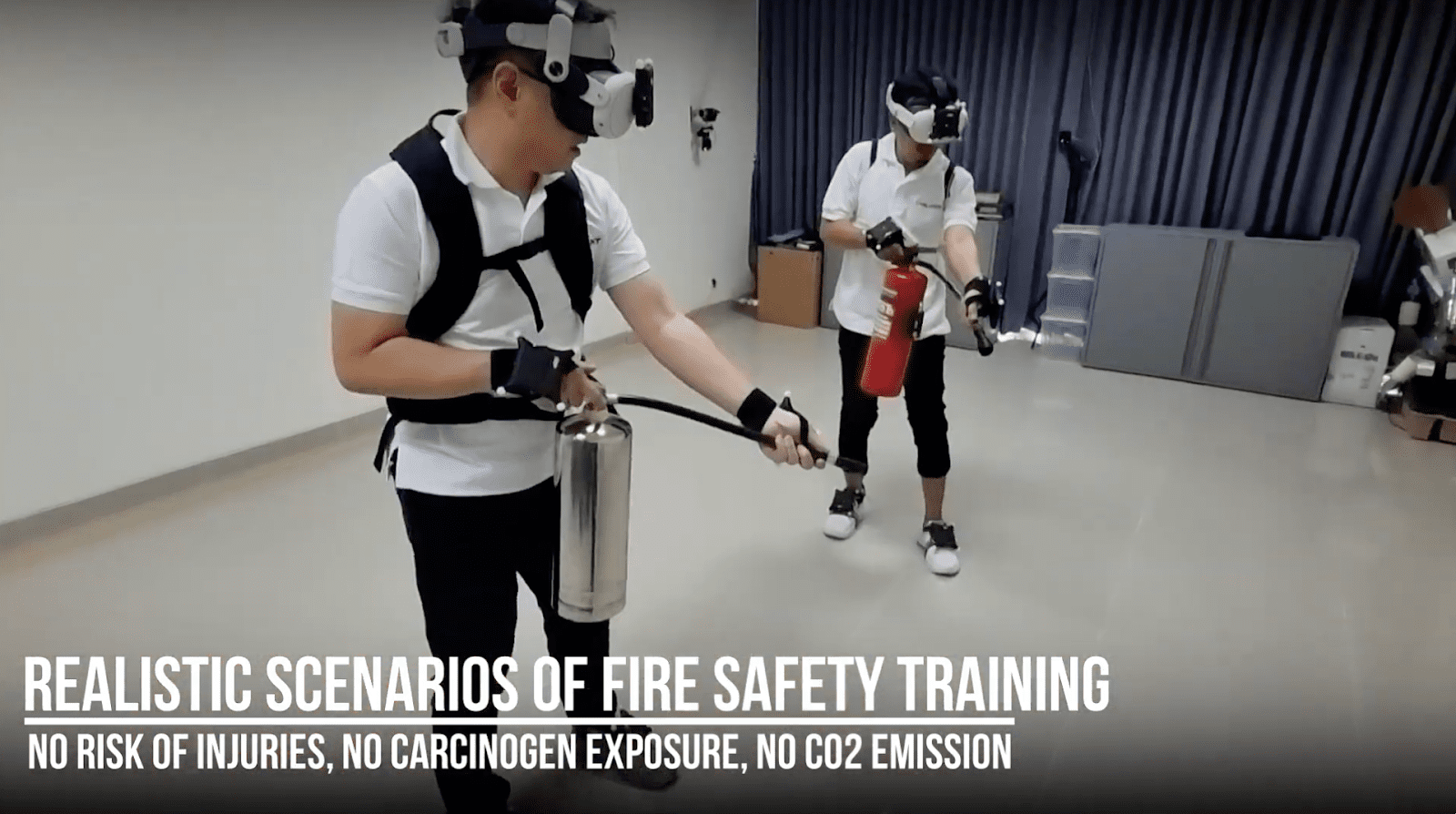
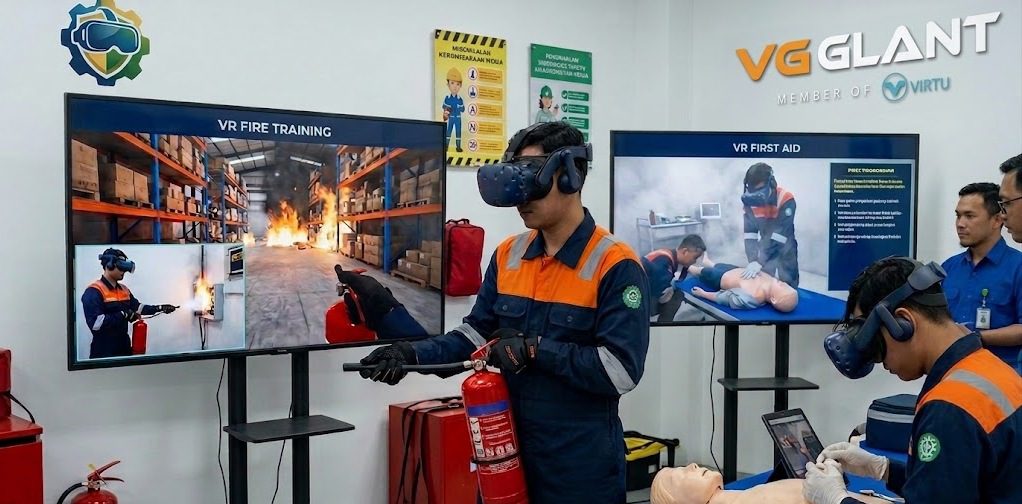
The setup is straightforward. A standalone headset, two motion controllers, and a defined scenario. Trainee puts on the headset and finds themselves inside a simulated environment — an office, a factory floor, a warehouse aisle, a kitchen, depending on the module loaded.
A fire scenario starts. Smoke fills the space. Alarms sound. The trainee has to act.
Every action is tracked. Where they look. Where they move. What they pick up. How quickly they respond. Did they pull the alarm before evacuating, or did they freeze. Did they pick up the right type of extinguisher for the fire class shown, or grab the nearest one. Did they aim at the base of the fire, or at the flames. The system logs all of it.
When the scenario ends, the trainee gets a score and a debrief. What they did right. What they missed. Which steps were out of sequence. They can run the same scenario again, or move to a different one with a different fire class, layout, or set of complications.
That’s the core loop. Headset, scenario, action, feedback, repeat.
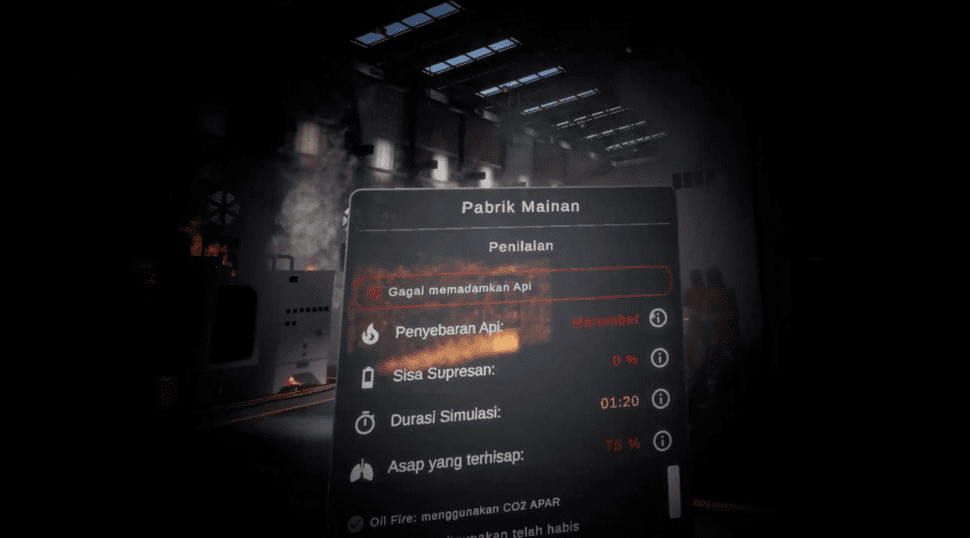
What scenarios can be drilled
The strength of VR safety training is scenario variety. Conventional training is constrained by what can safely be set up physically. VR isn’t.
For fire response specifically, the scenarios commonly drilled in VR include:
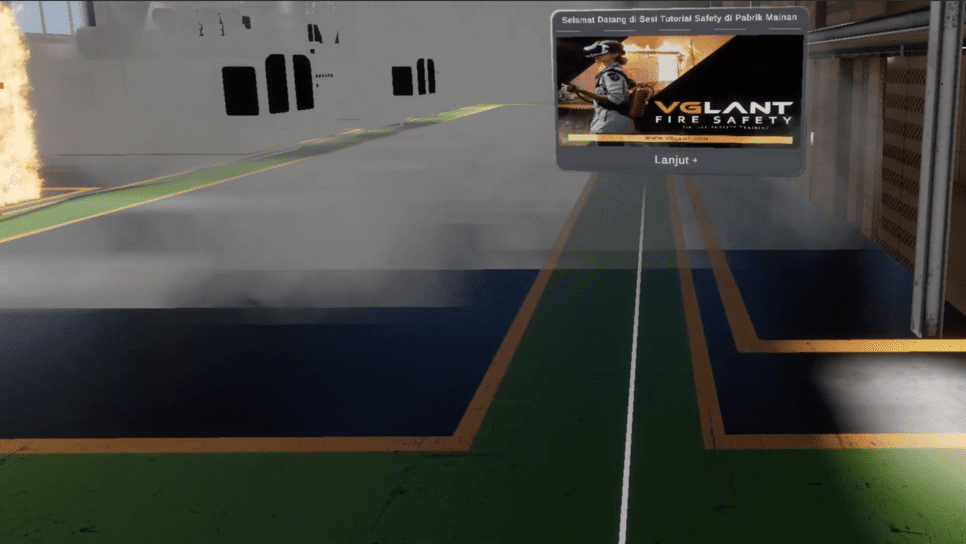
Office and commercial environment evacuation. Smoke obscuring exit signs, blocked stairwells, multi-floor coordination, assembly point procedure.
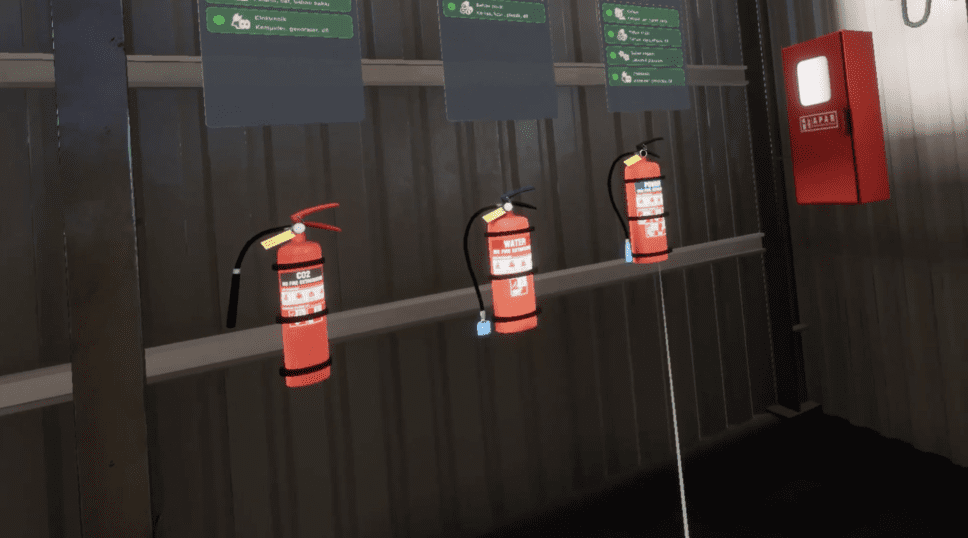
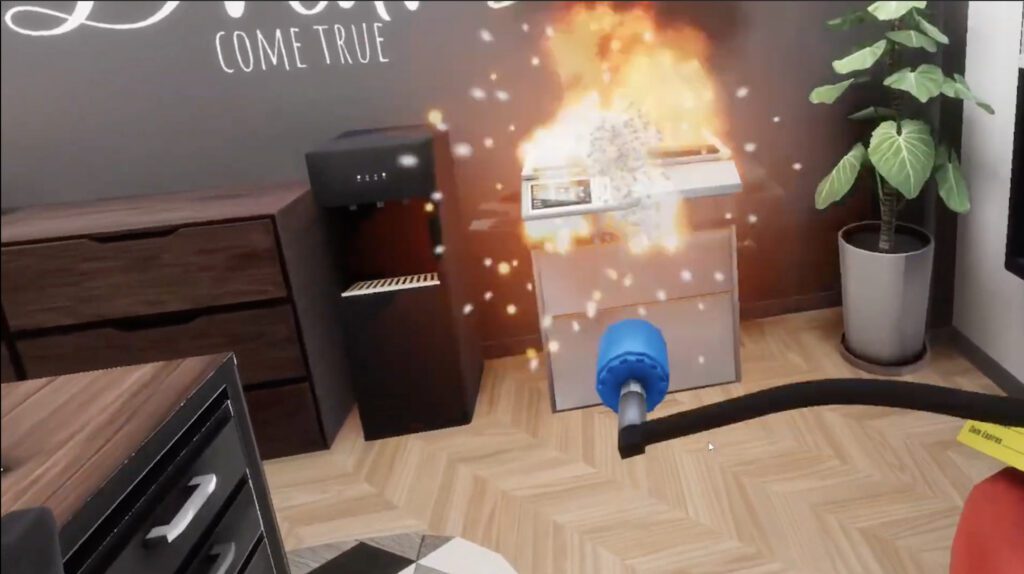
Industrial floor APAR response. Identifying the fire class, selecting the correct extinguisher, applying the PASS sequence (Pull, Aim, Squeeze, Sweep), and recognizing when the fire has grown beyond extinguisher capacity and evacuation is the correct call.
Kitchen and cooking media fires. Class K fires require specific suppression. Wet chemical extinguisher use. Why water is contraindicated for grease fires.
Electrical fires. Class C scenarios involving panels, transformers, or equipment. CO2 or dry chemical use. Why water is contraindicated and what happens if it’s used anyway.
Flammable liquid fires. Class B scenarios involving fuels, solvents, or paint. Foam or dry chemical agent selection. Containment versus suppression.
Warehouse and storage facility scenarios. Pallet fires, propagation patterns, lithium-ion battery fires (an increasing category for warehouses storing electronics or e-commerce inventory).
Hot work and welding-related fires. Construction site or fabrication shop scenarios. Spark suppression, fire watch protocol, immediate response.
Confined space fire response. Limited access, oxygen displacement concerns, coordination with rescue teams.
Hazardous material involvement. Fires where the burning material itself is the hazard, requiring specific agent selection and evacuation distance considerations.
Each scenario can be replayed with variables changed. Different starting locations, different team configurations, different times of day, different complications layered in. A single trainee can run through dozens of scenario variants in the time conventional training would cover one.
What makes VR effective for fire response training
Three operational properties.
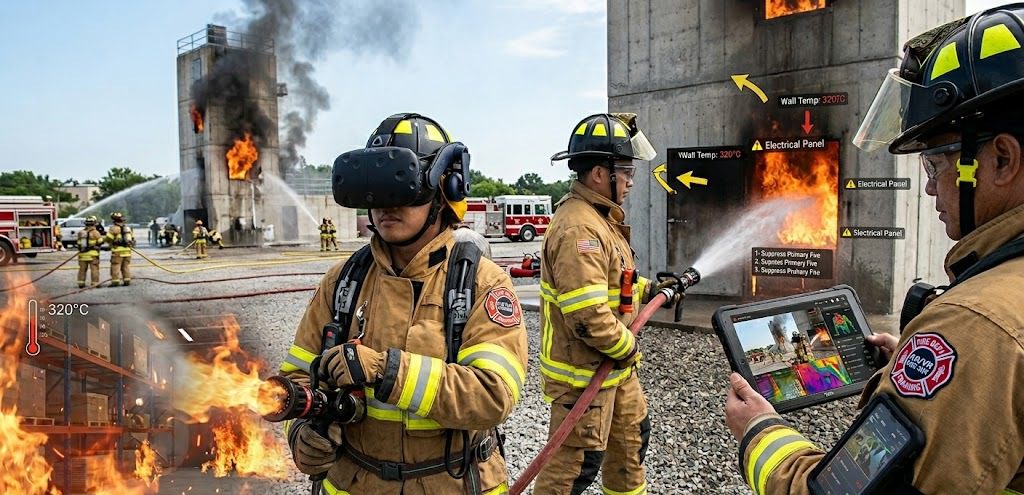
The first is scenario realism without physical risk. A trainee can experience smoke obscuring their vision, hear an alarm at realistic volume, navigate a degraded environment, and make decisions under time pressure. None of this requires actually creating a fire. The cognitive load is real even though the hazard isn’t.
The second is repeatability at low marginal cost. Once the program is in place, additional sessions cost nothing. A live evacuation drill takes hours of coordination. APAR training with real extinguishers consumes chemical and requires controlled burn conditions. A VR session takes 8 to 15 minutes and needs no instructor coordination once the system is set up. This is what makes monthly or quarterly practice operationally feasible.
The third is performance data. Every session generates measurable output. Time to first action. Path taken during evacuation. Equipment selected. Procedural compliance. This data accumulates over time, giving the K3 organization actual evidence of competency rather than attendance signatures from a session twelve months ago.
These three properties work together. Realism without risk lets you drill what you couldn’t otherwise drill. Repeatability lets you drill it often enough to actually retain the skill. Data lets you prove competency to auditors and identify which trainees need more practice.
What VR can drill that conventional training can’t
Several categories of scenario don’t have a practical conventional equivalent.
High-consequence rare events. A pressurized vessel rupture. A wellhead fire. A transformer explosion. These can’t be physically drilled because creating the conditions creates the hazard. They also can’t be effectively trained through tabletop discussion alone, because the cognitive load of the actual scene is what trainees need to prepare for.
Degraded visibility navigation. Smoke obscuring exit signs is the single most disabling factor in real fires. Conventional drills always run with full visibility. VR can simulate visibility degradation accurately, forcing trainees to navigate with limited information.
Decision-making under multiple simultaneous demands. Fire alarm sounding, secondary route blocked, bystander panicking, supervisor giving conflicting instructions. Real emergencies present multiple problems at once. VR can layer these in. Conventional drills typically run one issue at a time.
Wrong-agent selection consequences. In real APAR training, trainees use the correct extinguisher because that’s what’s provided. In VR, they can select the wrong one and see the consequence. Class B fire spreading because of water application. Class C fire creating an electrical hazard because of conductive agent use. Learning what not to do, by doing it in a setting where the lesson is the only consequence.
Repetition until automaticity. The PASS sequence, route memorization, role coordination, agent selection — these become reflexive only after repeated practice. Conventional training rarely provides enough repetition for that. VR removes the constraint that limits repetition.
The relationship to K3 compliance
Indonesian fire safety regulation under Permenaker No. 4 Tahun 1980 and Kepmenaker No. 186 Tahun 1999 sets the requirements for APAR, fire response teams (Tim Penanggulangan Kebakaran tiered Class A through D), and related competencies. The regulations are methodology-neutral. They specify what competency must exist, not how it gets trained.
VR safety training fits as a competency development and maintenance tool within this framework. It supplements accredited certification, which still comes from PMI, BNSP-recognized providers, or licensed K3 instructors. It supplements full-scale physical drills, which still happen for evacuation logistics and team coordination. What it adds is the practice frequency that conventional methods can’t deliver cost-effectively.
For audit purposes, the session data VR generates serves as competency evidence beyond attendance records. K3 auditors increasingly expect demonstrable competency, not just documentation of attendance. VR provides that.
Where VR safety training has limits
A few things worth being direct about.
It’s not a replacement for accredited certification. Petugas K3 kebakaran licensed under Kepmenaker 186/1999 must complete accredited courses. VR is not an accredited certification path.
It’s not a replacement for full-scale evacuation drills. Coordinating an entire workforce through actual building exits, with real assembly points and real headcount procedures, is something only physical drills cover. VR drills decisions and small-team scenarios, not workforce-wide logistics.
It’s not a complete substitute for live extinguisher handling. Most serious fire safety programs combine VR for scenario practice and decision-making with at least some live extinguisher experience for tactile familiarity. The two reinforce each other.
VR safety training is a tool. It covers what it covers well and doesn’t cover what it doesn’t. The mistake to avoid is treating it as a complete program by itself.
VGLANT fire safety modules
VGLANT is built by PT Virtu Digital Kusuma, an Indonesian AR, VR, MR, and Digital Twin company. Headquartered in Jakarta. Engineering in Bandung.
The fire safety catalog covers APAR operation across SNI fire classes (A, B, C, D, K), evacuation scenarios under degraded visibility, hazardous material fire response, confined space considerations, kitchen and cooking media fires, electrical fires, and tiered response scenarios aligned with Kepmenaker 186/1999 role definitions.
UI and voice prompts default to Bahasa Indonesia, with English available. Scenarios are modeled on Indonesian workplace environments, including the signage and layout conventions used in domestic facilities. Protocols align with Permenaker 4/1980 for APAR, Kepmenaker 186/1999 for response team competency tiers, and relevant SNI references.
The same hardware runs the rest of the VGLANT K3 catalog: CPR and first aid, hazardous material handling, confined space response. Headsets procured for fire safety extend across the broader catalog without additional hardware spend.
For module specifications or pilot scoping, contact enquiry@vglant.com or +62 818 0755 5538.