


Fire extinguisher training at most Indonesian companies runs in a relatively short format. An introduction to the PASS technique, a hands-on session with a controlled oil tray, then a certificate is handed out. As a basic introduction, this format is enough. But fire extinguishers actually carry many technical nuances that determine whether their use will be effective during an actual fire — and these nuances are hard for employees to grasp through lectures or brief practice alone.
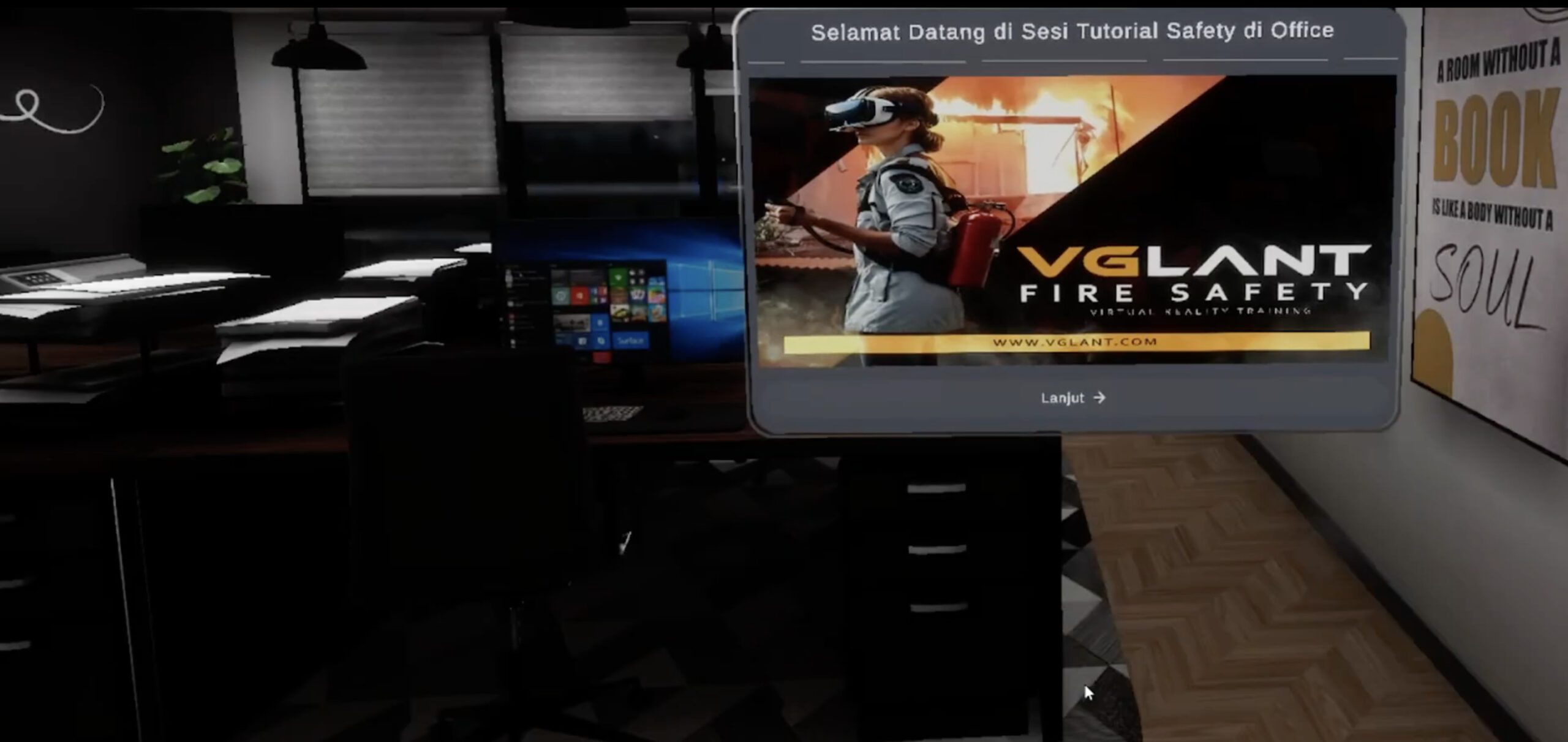
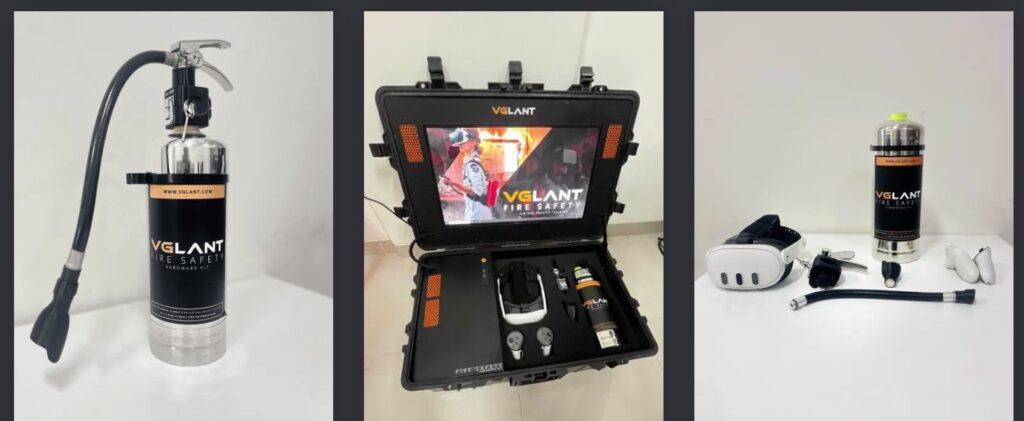
VR Safety Training provides space to discuss and rehearse these nuances safely and with proper documentation. Not as a replacement for hands-on training, but as a complement that makes employee understanding far more complete. The five lessons below are clear examples of how VR simulation can deepen employee understanding of a tool that is often treated as straightforward.
1. Fire Extinguishers Have Limited Capacity, and That Matters
Many employees don’t truly understand how long a single extinguisher can operate. The fact is, portable fire extinguishers typically hold 3 to 9 kilograms of suppressant agent with an operating time of around 8 to 25 seconds. That isn’t a long window. For small fires that have just started, this capacity is enough. For fires that have already spread beyond a few square meters, a single extinguisher rarely puts the flames out completely.
This understanding is hard to build through theory alone. When an employee reads that a fire extinguisher contains 6 kilograms of agent, the figure feels abstract. But when they experience an empty cylinder after 20 seconds in a VR simulation while the fire is still burning — the lesson about capacity limits sinks in differently. They learn to prioritize: hit the main fire point, don’t spray randomly, don’t stay too far from the source.
2. Each Fire Class Demands a Different Suppression Agent
This is the lesson with potentially fatal consequences. A water extinguisher used on an electrical panel can shock the operator. A powder extinguisher applied to hot cooking oil can cause splashing and spread the fire further. CO2 used in a small enclosed space can endanger the operator due to oxygen displacement.
Conventional fire extinguisher training generally presents only one type of extinguisher — usually ABC powder because it’s the most common — and one fire class. Employees rarely face a situation where they have to distinguish between Class A (wood, paper), Class B (flammable liquids), Class C (electrical), Class D (metals), and Class K (cooking oil), then choose the right suppression agent.
VR Safety Training allows all fire classes to be presented in a single training session. Participants experience an office fire scenario with burning cables, a kitchen fire with cooking oil flaring up, a warehouse fire with a fuel spill, or a fire in an electrical panel area. Understanding the match between fire class and suppression agent becomes a trained skill, not just memorized from a wall poster.
3. Pre-Operation Inspection Is Part of Using a Fire Extinguisher
Before pulling the pin, several quick checks should be performed: the pressure gauge needs to be in the green range, the pin seal must be intact, the hose shouldn’t be damaged, and the expiration date must not have passed. Many extinguishers mounted in Indonesian buildings turn out not to be in ready-to-use condition. Pressure drops from slow leaks. Service dates pass without facility teams noticing.
When a fire breaks out, the few seconds spent pulling the pin of an extinguisher that turns out not to work are seconds lost from the suppression window. This can be the difference between a fire that’s quickly put out and one that spreads.
VR Safety Training can include extinguishers in various conditions within its scenarios — some ready to use, some compromised. Participants learn to read pressure gauges, recognize signs of expired equipment, and quickly decide: “this one works” or “I need to find another”. This evaluation reflex is hard to build through hands-on training because of limitations in the number and types of extinguishers available.
4. Body Position and Safe Distance Determine the Outcome
The PASS technique taught in basic training mentions “sweep at the base of the fire”. What’s rarely emphasized is the distance the worker should stand at, the orientation relative to wind or airflow, and the body posture that allows for fast evacuation if the fire grows.
Wrong positioning traps the operator between fire and a wall, or places them in the path of smoke that blocks visibility. The consequences of poor positioning are hard to demonstrate convincingly in oil tray training — everything looks safe, distances appear adequate, smoke stays controlled.
In VR simulation, participants can experience the consequences of bad positioning without real danger. Visibility suddenly disappears. Heat feels more intense due to standing too close. Evacuation routes get blocked because of an unstrategic starting position. These spatial lessons form through experience, not through notes on a whiteboard.
5. When to Stop Trying and Start Evacuating
Perhaps the most important and most rarely trained lesson: recognizing when a fire has gone beyond the capability of a portable extinguisher, and when to stop, evacuate, and hand the situation over to professional firefighters.
A portable fire extinguisher is a tool for small fires that have just started. When flames have reached the ceiling, spread to several materials, or produced smoke filling the room, the chance of effective suppression drops sharply. Many fire victims are people who kept trying to put the fire out when they should have already evacuated — not out of bravery, but because they were never trained to recognize when a situation has moved beyond their capability.
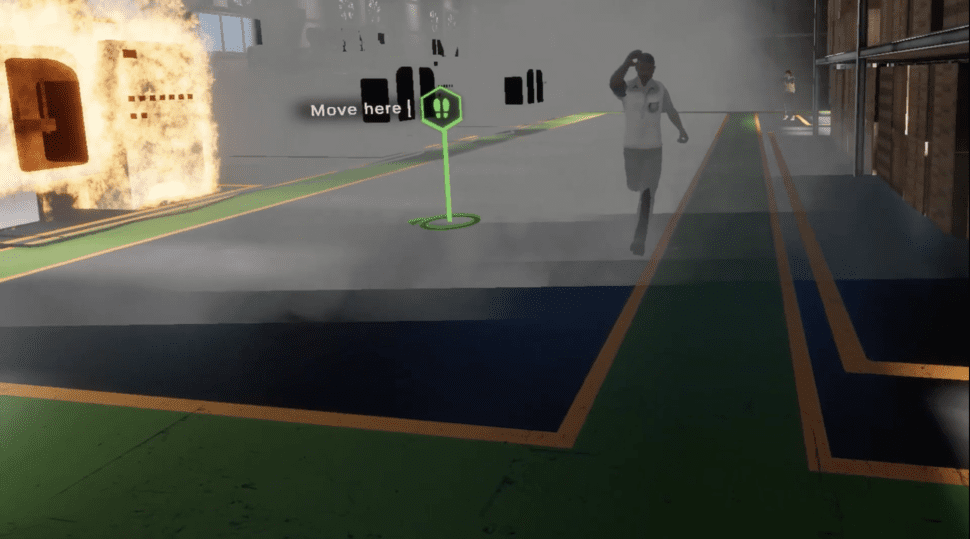
Conventional training rarely covers this stopping point, because a controlled oil tray never truly goes out of control. VR Safety Training can show realistic fire progression: spread to new fuel sources, smoke rising and filling the room, radiant heat that becomes overwhelming. Participants learn to read escalation cues and make the decision to retreat as part of professional reflex, not as personal failure.
The Place of VR Within a Broader Fire Extinguisher Program
Hands-on training with real extinguishers remains important for building feel of the equipment — the weight of the cylinder, the sensation of pressure during the squeeze, the actual spray distance. These components are hard to fully replicate in VR, and there’s no need to force it. What VR Safety Training contributes is space to train the cognitive and situational components that have long been hard to address — fire class identification, equipment evaluation, spatial awareness, and the decision to retreat.
Many facilities with complex risk profiles — chemical plants, energy facilities, high-rise office buildings, hospitals — already combine both approaches. Hands-on training at the start of the program to build motor foundations, followed by periodic VR sessions with varied scenarios. This combined approach produces readiness that is far more realistic than relying on a single method.
VGLANT develops fire safety and fire extinguisher operation modules mapped to Indonesian K3 standards, with scenarios that reflect actual Indonesian workplace conditions — high-rise offices, factories, warehouses, and commercial areas. This local approach helps training feel relevant, rather than acting as a translation of foreign contexts whose procedures don’t always apply.
Closing
PASS is the foundation of fire extinguisher use, not the whole picture. The five lessons above are layers of understanding that determine whether employees will use extinguishers correctly when fire breaks out, or simply follow a memorized motor sequence without grasping its technical context.
VR Safety Training does not replace hands-on extinguisher training. What it does is fill in the understanding side that conventional methods have struggled to reach, with the added benefit of performance documentation that helps HR and HSE teams identify which employees are truly ready and which still need reinforcement. For companies serious about fire safety, this consideration is worth being part of the training procurement discussion this year.
Enhance work-at-height safety with immersive VR training solutions from VGLANT. This cutting-edge technology helps workers recognize real-world hazards, improve reaction time, and significantly reduce the risk of accidents. Visit VGLANT to learn how VR training can elevate your company’s safety standards.