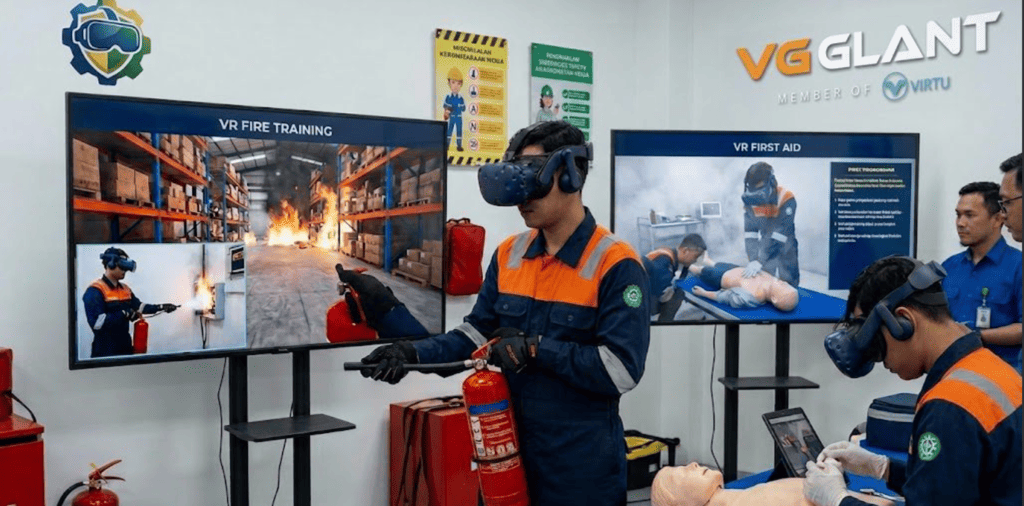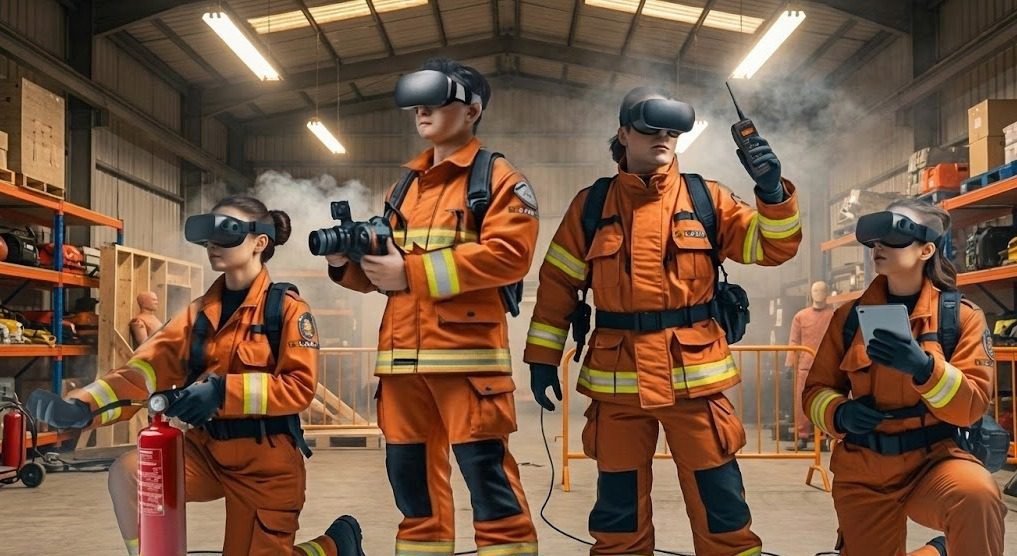


VR fire safety training uses a head-mounted display and motion controllers to place trainees inside a simulated fire scenario. The trainee acts as they would in a real emergency, the system tracks every action, and feedback is generated against established protocol. This piece covers how the training functions, what it can drill, and how it fits within Indonesian K3 fire safety programs.
Why traditional fire training has gaps
Conventional fire training in Indonesia uses a familiar set of tools. Classroom sessions on fire theory and APAR procedures. Annual evacuation drills. Live extinguisher practice with real burning fuel in controlled conditions. Tabletop exercises for response coordination. Each of these has a place. None of them, individually or together, fully closes the readiness gap for high-risk environments.
The reasons are practical rather than theoretical.
Live fire training carries inherent risk. Trainees handling real extinguishers near actual fires face heat exposure, smoke inhalation, and the potential for equipment failure. Controlled burns require safety officers, regulated environments, and consumable fuel. The cost and risk profile limits how often this training can run.
Most live training is also constrained to a narrow set of scenarios. Open-air fuel pan fires for Class B practice. Wood crib fires for Class A practice. Electrical mockups for Class C demonstrations. The variety conventional training can replicate is much smaller than the variety of real-world fire scenarios.
Annual evacuation drills happen with notice, in good visibility, with planned routes, on a schedule that accommodates production. Real fires happen without notice, often with smoke obscuring exit signs, sometimes with primary routes blocked, and on no schedule at all. The cognitive conditions of the drill don’t match the cognitive conditions of the actual event.
Skill retention sits behind all of this. Fire response procedures are perishable. Without regular practice, recall and execution both degrade. Annual training cycles meet regulatory requirements but don’t match the practice frequency that maintains operational readiness.
How VR fire training functions
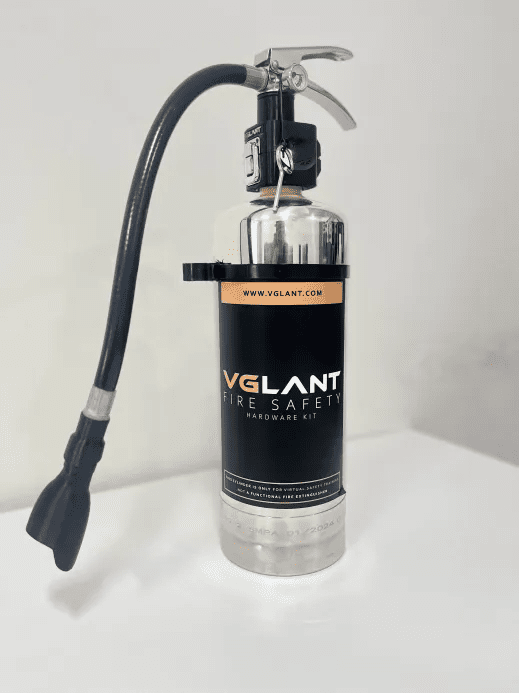
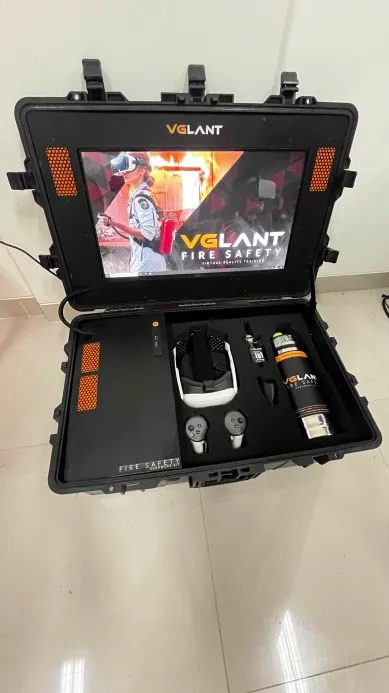
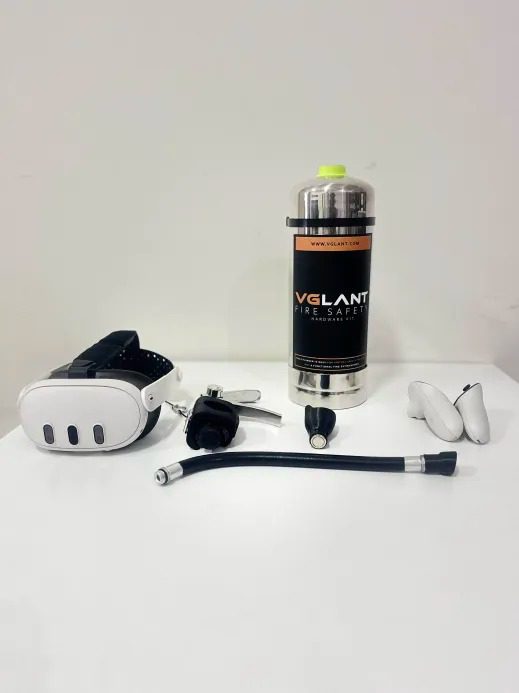
The hardware setup is consistent across most current platforms. A standalone headset (Meta Quest 3 and similar enterprise-tier devices are common in current Indonesian deployments). Two motion controllers tracked in 3D space. Optional accessories like physical extinguisher props with tracking sensors for hybrid scenarios.
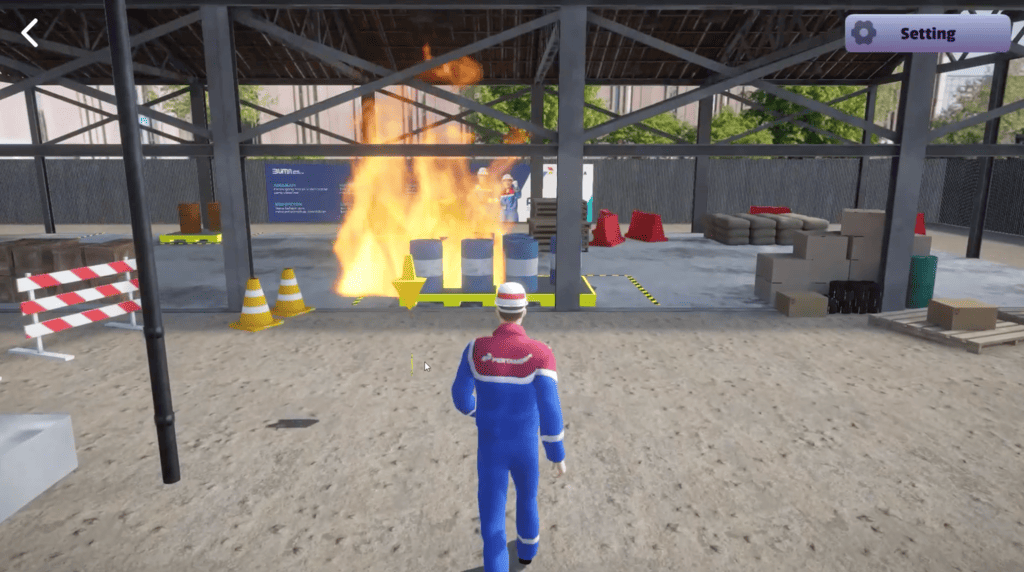
The trainee puts on the headset and enters a simulated environment. This might be an office, a warehouse aisle, a manufacturing floor, a kitchen, a parking structure, or any other workplace context the module is built around. Lighting, layout, signage, and equipment placement are rendered to match Indonesian workplace conventions when the content is locally produced.
A fire event begins. Smoke fills the space, reducing visibility. Alarms sound. The trainee has to assess the scene, decide on action, and execute. Available actions depend on the scenario design. Pulling a manual fire alarm. Calling for assistance. Selecting an extinguisher. Approaching the fire correctly. Aiming and applying the agent. Evacuating along an appropriate route. Reaching the assembly point.
Every action is tracked. Where the trainee looks. The timing of each decision. Equipment selection. Compliance with procedural sequence. Path taken through the environment.
When the scenario ends, the system generates a debrief. Score against protocol. Steps performed correctly. Steps missed or out of sequence. Specific feedback on extinguisher technique, route choice, or response timing. The trainee can replay the same scenario to improve, or move to a different scenario with different conditions.
What scenarios can be drilled in VR
Scenario variety is the operational strength of VR fire training. The categories commonly covered:
APAR operation across SNI fire classes. Class A (ordinary combustibles like paper, wood, textiles), Class B (flammable liquids), Class C (electrical), Class D (combustible metals), Class K (cooking media). Each class has appropriate and contraindicated agents. The PASS sequence — Pull, Aim, Squeeze, Sweep — is drilled in scenario context rather than as classroom recitation.
Office and commercial evacuation. Smoke obscuring exit signs. Multi-floor coordination. Stairwell navigation. Assembly point procedure. Scenarios where the primary route is blocked and an alternative must be chosen.
Industrial floor scenarios. Manufacturing environments with welding, hot work, flammable storage, or combustible dust. The procedural complexity changes with the environment, and VR can render multiple variants without setting up multiple physical training facilities.
Kitchen fires. Class K scenarios involving cooking oil and grease. Wet chemical extinguisher use. Why water application worsens grease fires.
Electrical fires. Class C scenarios involving panels, transformers, or equipment. CO2 or dry chemical agent selection. Why water and foam are contraindicated.
Flammable liquid fires. Class B scenarios involving fuels, solvents, or paints. Foam or dry chemical use. Containment versus suppression decisions.
Warehouse scenarios. Pallet fires, stacked storage propagation, lithium-ion battery fires (a category increasing in relevance for warehouses storing electronics or consumer electronics inventory).
Hot work scenarios. Construction sites, fabrication shops. Spark suppression, fire watch protocol, immediate response procedure.
Hazardous material involvement. Fires where the burning material itself is the hazard, requiring specific agent selection and evacuation distance considerations.
Each scenario can be replayed with variables changed. Different starting locations. Different times of day. Different layered complications. A single trainee can run dozens of scenario variants in the time conventional training would cover one.
What VR addresses that conventional training doesn’t
Three operational gaps in particular.
The first is exposure to scenarios that can’t be physically replicated. A pressurized vessel rupture in a chemical facility. A wellhead fire on an oil and gas site. A transformer fire in a substation. These scenarios require specific response procedures that diverge from generic fire response. They can’t be physically practiced because creating the scenario means creating the actual hazard. They also can’t be effectively trained through tabletop discussion alone, because the cognitive load of an active scene is what trainees need to prepare for.
The second is wrong-action consequences without real consequences. In live training, trainees use the correct extinguisher because that’s what’s provided. They never see what happens when water is applied to a Class B liquid fire and the fire spreads. They never see what happens when water touches a Class C electrical fire. VR can simulate these wrong-agent outcomes safely, which is one of the more effective ways to drill correct selection.
The third is repetition at low marginal cost. Live extinguisher training consumes chemical and requires controlled burn conditions. Evacuation drills require workforce coordination. VR sessions take 8 to 15 minutes per scenario, can be run by a single trainee on the headset whenever the schedule allows, and require no instructor coordination once the program is set up. Monthly or quarterly practice becomes feasible. So does targeted refresher right before a high-risk operation. So does new-hire onboarding within the first week of work.
The combination matters. Realism without risk lets trainees drill what couldn’t otherwise be drilled. Repeatability lets them drill it often enough for retention. Performance data lets the K3 organization actually verify competency rather than infer it from attendance.
Integration with K3 compliance in Indonesia
Indonesian fire safety regulation centers on two main rules. Permenaker No. 4 Tahun 1980 covers APAR placement, inspection, and personnel competency. Kepmenaker No. 186 Tahun 1999 covers fire prevention and response, including the tier structure for fire response teams (Tim Penanggulangan Kebakaran) — Class D (peran kebakaran), Class C (regu penanggulangan kebakaran), Class B (koordinator unit penanggulangan kebakaran), and Class A (ahli K3 spesialis penanggulangan kebakaran). Permen PUPR No. 26 Tahun 2008 covers building fire protection and management. Sectoral overlays apply for oil and gas (Migas), mining (ESDM), and healthcare (Kemenkes), along with relevant SNI standards.
The regulations specify what competencies must exist. They don’t specify how training is delivered. This leaves room for VR within a compliance program structured as follows:
Initial certification through accredited providers (PMI, BNSP-recognized centers, licensed K3 instructors) satisfies the licensing requirements under Kepmenaker 186/1999. This is unchanged. VR is not an accredited certification path.
Between certifications, VR provides skill maintenance through scenario practice. Sessions are run at whatever frequency the organization sets, typically monthly or quarterly. Each session generates competency telemetry that supplements certification records.
Full-scale evacuation drills continue to occur for workforce-wide coordination, since this is something only the physical drill covers. VR drills decisions and small-team scenarios, not building-wide logistics.
Field training for response teams (Class A and Class B under Kepmenaker 186/1999) continues for hands-on physical practice. VR supplements this rather than replacing it.
The audit benefit is concrete. K3 inspectors increasingly expect demonstrable competency rather than just documentation of attendance. Session logs from VR provide that, exportable as competency evidence per trainee, per scenario, over time.
Reporting and performance tracking
Each VR session produces measurable output. The data points commonly captured:
Time to first action. How quickly the trainee responded after the scenario started.
Path taken during evacuation. Route chosen, deviations, dead ends entered.
Equipment selection. Which extinguisher type was selected for the fire class shown.
Procedural compliance. Whether steps were performed in correct sequence.
PASS technique scoring (where applicable). Position, aim, agent application, sweep pattern.
Time to safe state. How long until the fire was extinguished or the trainee reached the assembly point.
Aggregate reports across the workforce identify which scenarios are weakest organization-wide, which trainees need additional practice, and how competency trends over time. This data is useful for K3 audits, internal reviews, and identifying gaps before they become incident contributors.
What VR doesn’t replace
Worth being direct about the limits.
Accredited certification still comes from PMI, BNSP-recognized providers, or licensed K3 instructors. VR is not a substitute.
Full-scale evacuation drills still happen for workforce-wide logistics. VR doesn’t cover building-scale coordination.
Some hands-on tactile training still benefits from physical practice. Live extinguisher familiarity, even at reduced frequency, complements VR scenario practice rather than being replaced by it.
VR fire safety training is one tool in a layered K3 program. It covers what it covers well — scenario variety, practice frequency, performance data — and doesn’t cover what it doesn’t. The mistake to avoid is treating it as a complete fire safety program by itself.
VGLANT fire safety modules
VGLANT is built by PT Virtu Digital Kusuma, an Indonesian AR, VR, MR, and Digital Twin company. Headquartered in Jakarta. Engineering in Bandung.
The fire safety catalog covers APAR operation across SNI fire classes (A, B, C, D, K), evacuation under degraded visibility, hazardous material fire response, kitchen and electrical fire scenarios, hot work and welding-related fires, and tiered response scenarios aligned with Kepmenaker 186/1999 role definitions.
UI and voice prompts default to Bahasa Indonesia, with English available. Scenarios are modeled on Indonesian workplace environments, including signage and layout conventions used in domestic facilities. Protocols align with Permenaker 4/1980 for APAR, Kepmenaker 186/1999 for response team competency, and relevant SNI references.
Hardware runs on standalone headsets, currently in the IDR 7 to 25 million range per unit depending on consumer-grade Meta Quest 3 or enterprise-tier devices with managed software. Content licensing is priced per-seat or per-site annually, separate from hardware.
The same hardware runs the rest of the VGLANT K3 catalog: CPR and first aid, hazardous material handling, confined space response. Headsets procured for fire safety extend across the broader catalog without additional hardware spend.
For module specifications or pilot scoping, contact enquiry@vglant.com or +62 818 0755 5538.