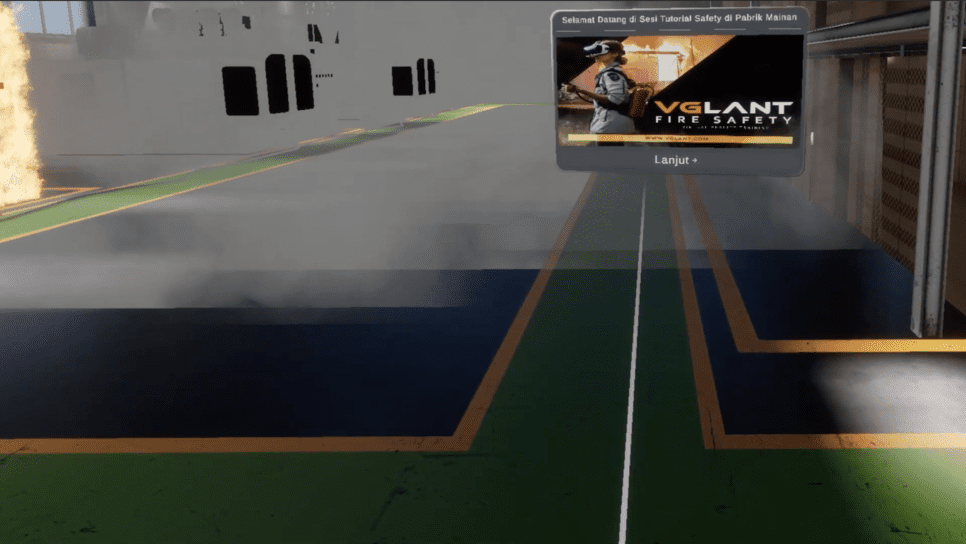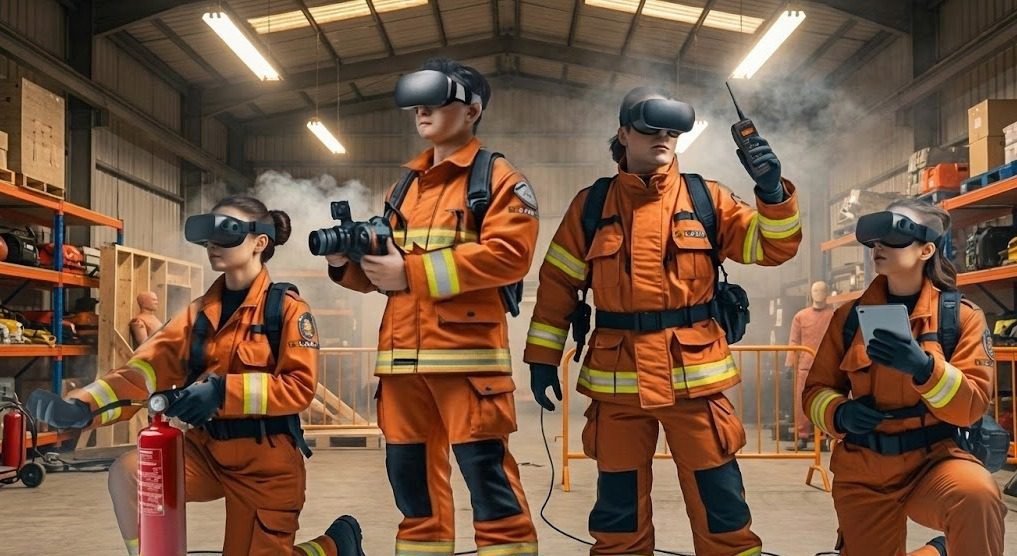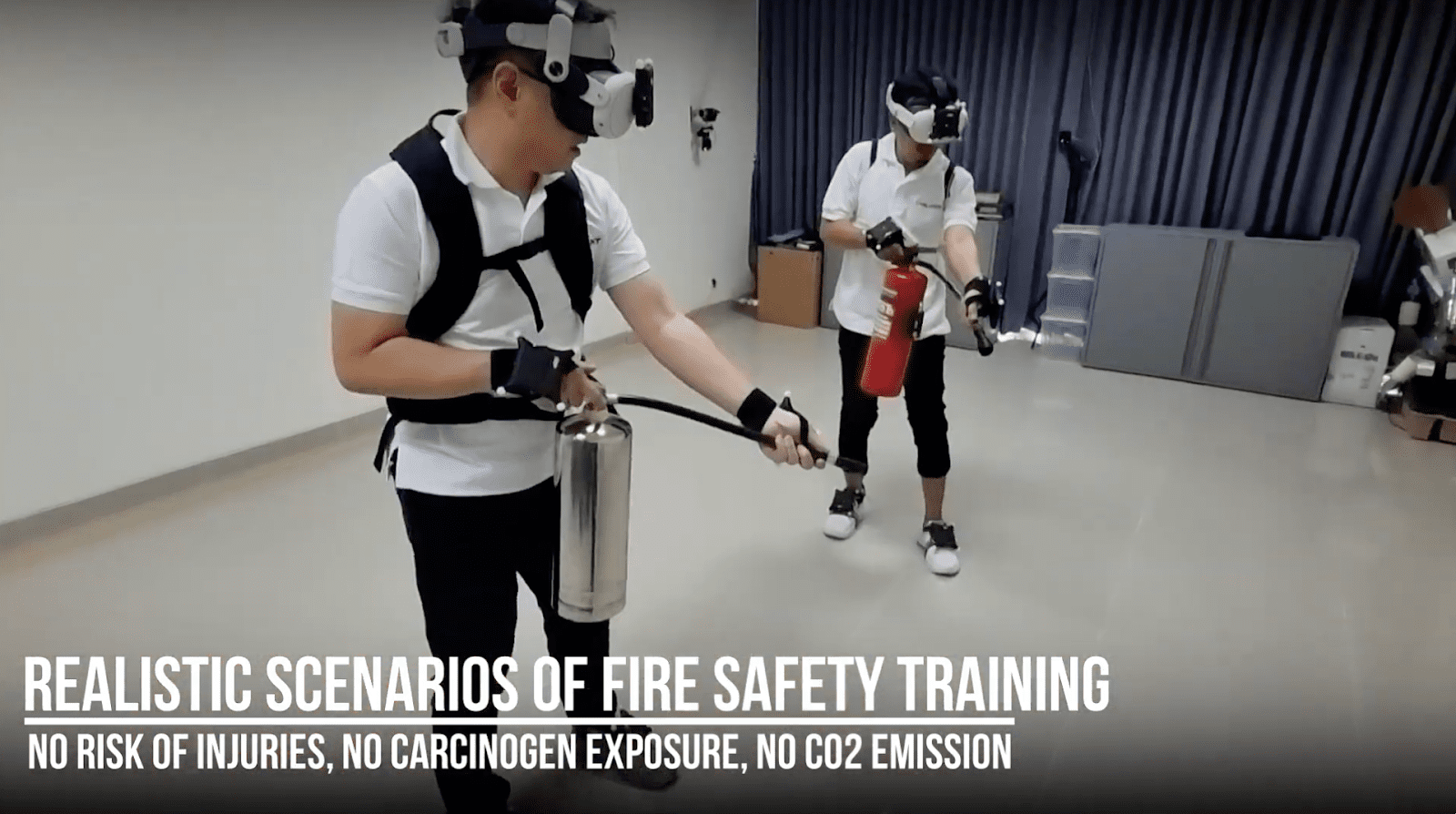


VR working at height training places trainees inside a simulated elevated environment using a head-mounted display and motion controllers. The trainee performs fall protection procedures, identifies hazards, and uses harness systems as they would in real conditions. Every action is tracked, scored against protocol, and logged for review. This piece covers how the training works, what it can drill, and how it fits within Indonesian working at height compliance.
Why working at height training matters in Indonesia
Falls from elevation are among the most common causes of serious workplace injury and fatality in Indonesian high-risk sectors. Construction, telecommunications, oil and gas, manufacturing, warehousing, and building maintenance all involve regular work above ground level. The hazards range from open edges and unprotected platforms to scaffolding collapse, ladder misuse, anchor point failure, and improper personal protective equipment (PPE).
Indonesian regulation recognizes the elevated risk and addresses it directly. Permenaker No. 9 Tahun 2016 governs occupational safety and health in working at height. The regulation defines working at height as work performed on a surface with a fall risk of 1.8 meters or higher, and it sets requirements for technique, equipment, planning, and personnel competency. Two licensed worker categories sit at the center of this framework. TKBT (Tenaga Kerja Bangunan Tinggi) covers workers operating on high buildings using temporary or permanent access systems. TKPK (Tenaga Kerja Pada Ketinggian) covers workers using rope access methods, with three competency levels (Level 1, 2, and 3).
The regulation specifies who must be trained, what competencies must be demonstrated, and what equipment and procedures are required. It does not specify how that competency is built or maintained. That part is left to the employer.
Why traditional working at height training has gaps
Conventional working at height training in Indonesia uses a familiar mix. Classroom theory on regulation and equipment. Practical sessions on harness inspection and PASS-equivalent fitting procedures. Demonstration of fall arrest systems on training rigs. Some providers run live rope access practice for TKPK certification levels. PMI, BNSP-recognized training centers, and licensed K3 instructors handle most of this.
The training works for what it covers. It also has predictable gaps.
Live training on actual structures carries inherent risk. Even controlled training rigs require safety officers, fall arrest backups, and graded exposure. The cost and risk profile limits how many scenarios can be safely run, and how often.
Most live training is constrained to a narrow set of physical setups. A scaffold mockup. A fixed anchor point demonstration. A rope access training tower. Workplaces in the field present a much wider variety of conditions, including degraded structures, weather effects, dynamic loads, and emergency scenarios that can’t be safely created in a training facility.
Hazard recognition is also undertrained. Identifying a deficient anchor point, recognizing scaffold instability, spotting damaged harness components, or judging fall clearance distance — these are perceptual skills that require repeated exposure. Conventional training touches them. It rarely drills them deeply enough for the skill to become reflexive.
Skill retention applies here as it does to other emergency response domains. Without regular practice, recall and execution degrade. Annual refresher meets regulatory requirements but doesn’t keep working-at-height judgment sharp through the eleven months in between.
How VR working at height training functions
The hardware setup is consistent with other VR safety training categories. A standalone headset, currently Meta Quest 3 or comparable enterprise-tier devices in most Indonesian deployments. Two motion controllers tracked in 3D space. Optional accessories for some scenarios, including weighted props or actual harness components used alongside the simulation.
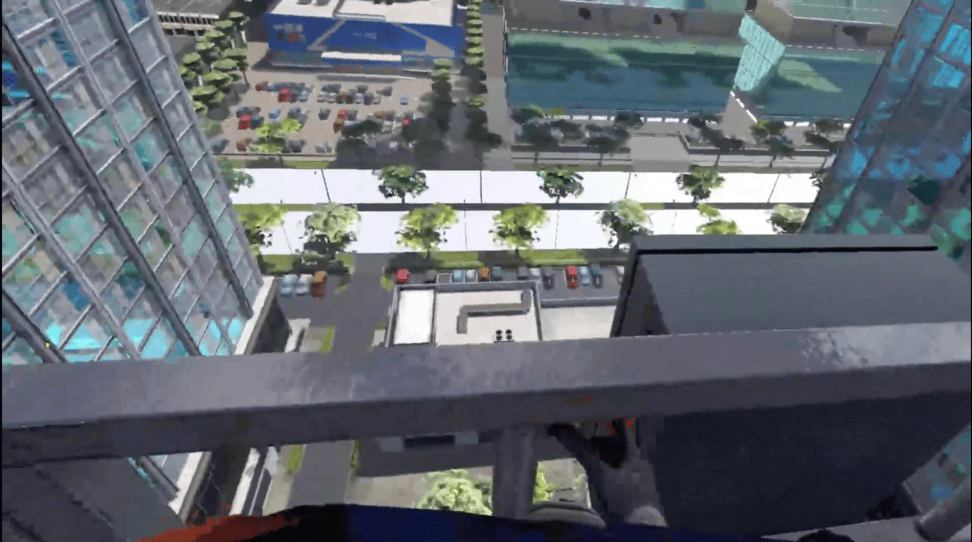
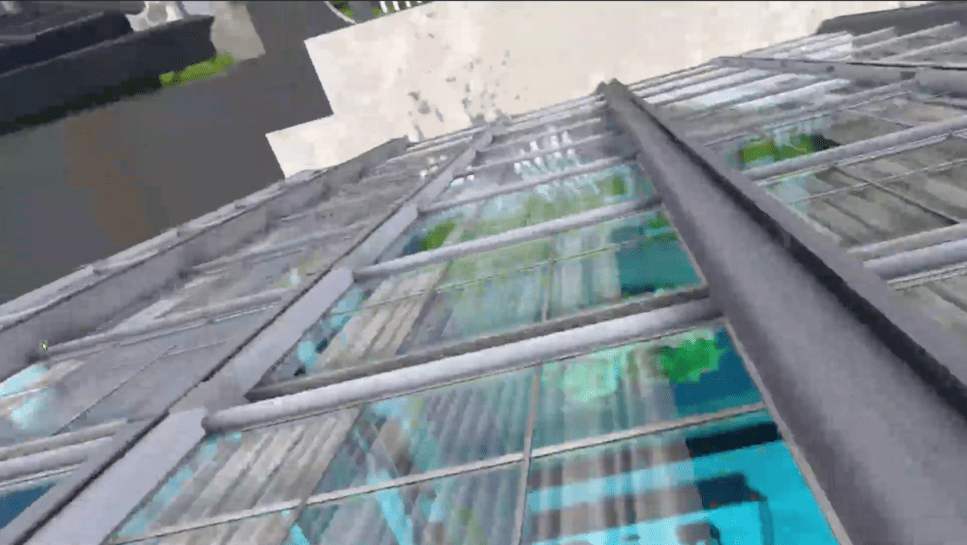
The trainee puts on the headset and enters a simulated environment at elevation. This might be a scaffolded construction site, a telecommunications tower, an industrial rooftop, an offshore platform deck, an elevated work platform, or any other context the module is built around. Lighting, layout, equipment placement, and safety signage are rendered to match Indonesian workplace conventions when the content is locally produced.
The trainee performs procedures as they would on site. Pre-work hazard assessment of the elevated area. Harness inspection across all components — webbing, stitching, buckles, D-rings, lanyards, energy absorbers. Donning and adjusting the harness. Anchor point selection and verification. Fall clearance calculation. Movement on elevated surfaces with appropriate tie-off discipline. Use of self-retracting lifelines, lanyards, or rope access systems depending on the scenario. Response to fall events and rescue procedures.
Every action is tracked. Whether the trainee inspected each harness component before donning. Whether the anchor point selected meets load requirements. Whether the fall clearance calculation accounts for body length, lanyard extension, deceleration distance, and safety margin. Whether tie-off discipline is maintained during movement. The system logs all of it.
When the scenario ends, the trainee gets a debrief. Score against protocol. Steps performed correctly. Steps missed or out of sequence. Specific feedback on harness fit, anchor selection, or movement technique. The trainee can replay the same scenario or move to a different one with different conditions.
What scenarios can be drilled in VR
Scenario variety is the operational strength of VR. The categories commonly covered for working at height:
Pre-work hazard assessment. Identifying deficient anchor points, recognizing scaffold instability indicators, spotting damaged harness components, judging environmental conditions including wind and surface stability.
Harness inspection. Component-by-component check before each use. Recognition of webbing damage, stitching wear, buckle deformation, D-ring deformation, lanyard fraying, energy absorber deployment indicators.
Harness donning and adjustment. Correct sequence, strap tension, leg loop placement, chest strap positioning, dorsal D-ring location.
Anchor point selection and verification. Load capacity assessment, structural adequacy, position relative to work area, swing fall avoidance.
Fall clearance calculation. Lanyard length plus deceleration distance plus body length plus safety factor versus actual available clearance below the work area.
Tie-off discipline. 100% tie-off during movement, transition between anchor points, double-lanyard procedure, twin tail considerations.
Scaffolding work. Movement across scaffold platforms, recognition of inadequate guardrails, ladder access procedures, working above other workers.
Tower and structure climbing. Telecommunications towers, cooling towers, transmission structures. Three-point contact, proper climbing equipment, fall arrest while climbing.
Rope access scenarios for TKPK competency. Level 1, 2, and 3 procedures aligned with Indonesian rope access certification structure. Knot tying, descender and ascender use, mid-rope transitions, edge management.
Mobile elevated work platform (MEWP) operation. Pre-use inspection, ground condition assessment, working envelope awareness, tie-off requirements within the platform.
Rescue scenarios. Suspension trauma awareness, rescue procedure activation, casualty stabilization, emergency descent. These scenarios are particularly valuable in VR because they’re difficult to drill safely in conventional training.
Emergency response after a fall arrest event. Self-rescue where possible, partner rescue procedures, response to suspension trauma, post-incident reporting.
Each scenario can be replayed with variables changed. Different anchor configurations. Different weather conditions. Different complications layered in. A single trainee can run dozens of scenario variants in the time conventional training would cover one.
What VR addresses that conventional training doesn’t
Three operational gaps in particular.
The first is exposure to scenarios that can’t be physically replicated. A worker losing footing on a wet rooftop. A scaffold collapse in progress. An anchor point failure during a fall. A suspension trauma event. These scenarios require specific response procedures, and they can’t be safely practiced because creating the scenario means creating the actual hazard.
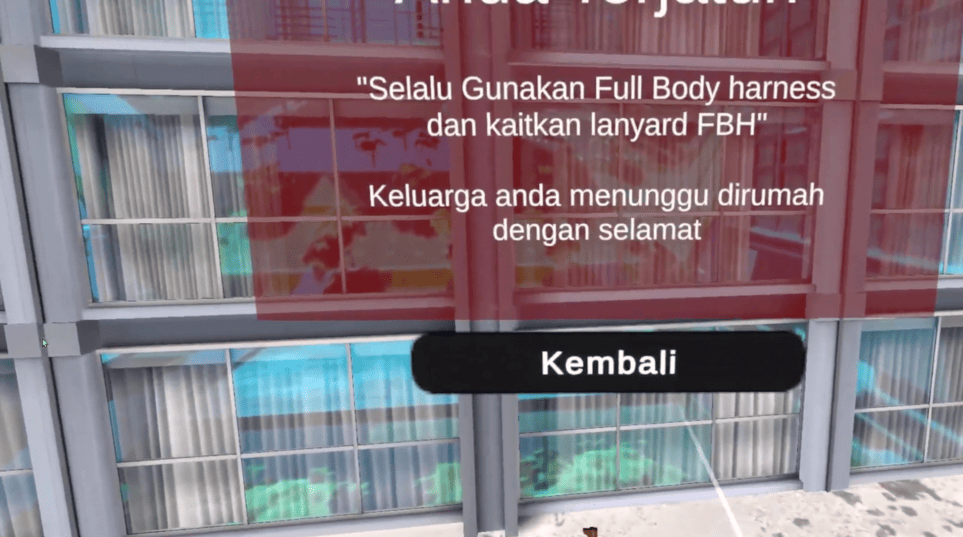
The second is wrong-action consequences without real consequences. In live training, trainees use the correct anchor point, the correct lanyard length, the correct fall clearance calculation, because errors are corrected before they become hazards. In VR, the trainee can select an inadequate anchor point and see what would happen during a fall event. They can miscalculate fall clearance and see the consequence in simulated form. Learning what not to do, by seeing what happens when you do it, is one of the more effective ways to drill correct procedure.
The third is repetition at low marginal cost. Live working at height training requires controlled facilities, safety officers, fall arrest backup systems, and graded exposure protocols. VR sessions take 10 to 20 minutes per scenario, can be run by a single trainee on the headset whenever the schedule allows, and require no instructor coordination once the program is set up. Monthly or quarterly practice becomes feasible. So does targeted refresher right before a high-risk operation. So does new-hire orientation in the first week of work.
The combination matters. Realism without risk lets trainees drill what couldn’t otherwise be drilled. Repeatability lets them drill it often enough for retention. Performance data lets the K3 organization actually verify competency rather than infer it from attendance.
Integration with Indonesian working at height compliance
Permenaker No. 9 Tahun 2016 sets the requirements for working at height in Indonesia. The regulation is methodology-neutral on training delivery, which leaves room for VR within a compliance program structured as follows:
Initial certification through accredited providers (BNSP-recognized training centers, licensed K3 instructors, registered TKBT and TKPK training providers) satisfies the licensing requirements under Permenaker 9/2016. This is unchanged. VR is not an accredited certification path for TKBT or TKPK competency.
Between certifications, VR provides skill maintenance through scenario practice. Sessions run at whatever frequency the organization sets, typically monthly or quarterly. Each session generates competency telemetry that supplements certification records.
Live practical training continues to occur for hands-on tactile familiarity with actual harness, lanyard, and rope access equipment. VR scenario practice complements this rather than replacing it. The two reinforce each other — VR drills decision-making and procedural sequence, live practice drills tactile handling.
Field supervision and toolbox talks continue for site-specific hazard discussion. VR doesn’t substitute for site-specific risk assessment and pre-work briefings.
The audit benefit is concrete. K3 inspectors increasingly expect demonstrable competency rather than just documentation of attendance. Session logs from VR provide that — exportable as competency evidence per trainee, per scenario, over time.
Reporting and performance tracking
Each VR session produces measurable output. The data points commonly captured for working at height scenarios:
Time to first hazard identification. How quickly the trainee recognized hazards present in the scene.
Harness inspection completeness. Whether each component was checked before donning.
Anchor point selection accuracy. Whether the chosen anchor met load and positioning requirements.
Fall clearance calculation accuracy. Whether the calculation accounted for all required factors.
Tie-off discipline percentage. What proportion of movement time was spent appropriately tied off.
Procedural compliance score. Whether steps were performed in correct sequence.
Response time to simulated fall events. How quickly emergency procedures were initiated.
Aggregate reports across the workforce identify which scenarios are weakest organization-wide, which trainees need additional practice, and how competency trends over time. This data supports K3 audits, internal reviews, and gap identification before incidents occur.
Sectors where VR working at height training applies most directly
Construction and infrastructure. Scaffolding, formwork, structural steel, roof work, façade installation, MEP installation in elevated areas. Indonesian construction sites operating under K3 Konstruksi frameworks face daily fall exposure across the workforce.
Telecommunications. Tower climbing, antenna installation, microwave link maintenance, transmission line work. TKPK Level 2 and Level 3 competencies are common in this sector.
Oil and gas. Offshore platform work, refinery elevated structures, tank inspection, flare stack maintenance. Migas frameworks layer additional safety requirements on top of Permenaker 9/2016.
Power generation and transmission. Transmission tower work, substation elevated equipment, wind turbine maintenance, hydroelectric facility infrastructure.
Manufacturing. Elevated workstations, crane and overhead equipment maintenance, mezzanine work, large equipment service requiring elevated access.
Warehousing and logistics. High-rack storage, mezzanine operations, conveyor system maintenance at height, building maintenance for large-format facilities.
Building maintenance and façade work. Window cleaning at height, façade inspection and repair, HVAC equipment service on elevated platforms or rooftops.
For these sectors, VR isn’t the only tool. It’s one of the more practical ones available given the cost structure and risk profile of alternatives.
What VR doesn’t replace
Worth being direct about the limits.
Accredited certification still comes from BNSP-recognized providers and licensed instructors operating under Permenaker 9/2016. TKBT and TKPK licenses are not issued through VR-based training.
Live practical training on actual harness, lanyard, and rope access equipment remains necessary for tactile familiarity. Controller haptics aren’t equivalent to handling actual webbing, buckles, descenders, and ascenders.
Site-specific hazard assessment and toolbox talks continue to be done by qualified supervisors at the actual work site. VR scenario practice doesn’t substitute for assessing the specific anchor points, surface conditions, and weather at the location where work will be performed.
VR working at height training is one tool in a layered K3 program. It covers what it covers well — scenario variety, practice frequency, performance data, exposure to scenarios that can’t be physically practiced — and doesn’t cover what it doesn’t. The mistake to avoid is treating it as a complete working at height program by itself.
VGLANT working at height modules
VGLANT is built by PT Virtu Digital Kusuma, an Indonesian AR, VR, MR, and Digital Twin company. Headquartered in Jakarta. Engineering in Bandung.
The working at height catalog covers harness inspection and donning, anchor point selection, fall clearance calculation, scaffolding work scenarios, tower climbing, MEWP operation, and tiered rope access scenarios aligned with TKPK Level 1, 2, and 3 procedures under Permenaker 9/2016. Rescue and post-fall response scenarios are included alongside standard work scenarios.
UI and voice prompts default to Bahasa Indonesia, with English available. Scenarios are modeled on Indonesian workplace environments, including signage, equipment, and structural conventions used in domestic facilities. Protocols align with Permenaker 9/2016 for working at height, BNSP TKBT and TKPK competency references, and relevant SNI standards.
Hardware runs on standalone headsets, currently in the IDR 7 to 25 million range per unit depending on consumer-grade Meta Quest 3 or enterprise-tier devices with managed software. Content licensing is priced per-seat or per-site annually, separate from hardware.
The same hardware runs the rest of the VGLANT K3 catalog: fire safety, CPR and first aid, hazardous material handling, confined space response. Headsets procured for working at height extend across the broader catalog without additional hardware spend.
For module specifications or pilot scoping, contact enquiry@vglant.com or +62 818 0755 5538.