

Confined space work kills people in Indonesia every year, and the pattern of those incidents is depressingly consistent. A worker enters a tank or vessel for inspection or cleaning. The atmosphere is not what was assumed. The worker loses consciousness. A second worker enters to rescue the first, without breathing apparatus, and also loses consciousness. Sometimes a third. By the time emergency response is called and properly equipped, two or three people are already down.
The technical term for this is multiple-fatality confined space incident. The pattern shows up repeatedly in oil and gas, palm oil milling, sewage treatment, ship repair, chemical processing, and any sector where workers periodically enter enclosed spaces that aren’t designed for continuous occupancy. What makes these incidents almost uniquely tragic is that they’re highly preventable. The procedures that prevent them are well-established. The training that drills those procedures has historically been the weak link.
This article looks at how VR-based training fits into confined space competency in Indonesia, what scenarios it handles well, and how it sits alongside the requirements set by Permenaker No. 9 Tahun 2010.
What “confined space” actually means under Indonesian regulation
Permenaker No. 9 Tahun 2010 (Operator dan Petugas K3 di Ruang Terbatas) is the operative regulation. A confined space in this framework has three defining characteristics: it is large enough for a worker to enter and perform work, it has limited or restricted means of entry and exit, and it is not designed for continuous occupancy.
That covers a wide range of physical spaces. Storage tanks for fuel, chemicals, or water. Process vessels and reactors. Boiler drums. Cooling towers. Silos for grain, cement, or feedstock. Sewer manholes. Pump and valve pits. Crawl spaces under building floors. Ductwork large enough to enter. Ship cargo holds and ballast tanks.
Permenaker 9/2010 also defines two roles that need formal training: the Petugas Utama (entrant, the worker who goes inside) and the Petugas Madya (attendant, the worker who stays outside and monitors). Both require BNSP-recognized certification through accredited training providers. A third role, the entry supervisor or pengawas pekerjaan, is typically held by a site safety officer or the work area supervisor and is responsible for issuing the entry permit.
The regulation specifies that entry must follow a permit system. Atmospheric testing must be performed before entry. Ventilation must be in place where required. The attendant must maintain continuous contact with the entrant. Rescue capability must be available without requiring the attendant to enter the space.
What the regulation specifies in detail is what should happen. What it doesn’t specify is the cognitive readiness of the people performing those steps under real conditions. That gap is where most fatal incidents actually occur.
Why conventional confined space training falls short
The standard training format is three to five days of classroom instruction, supplemented by some physical practice with the actual equipment — gas monitors, harnesses, retrieval systems, breathing apparatus, communication devices. Trainees pass a written exam and a practical demonstration. They get certified. Three years later, they re-certify.
Three problems with this pattern.
First, the practical demonstrations happen in a setup that doesn’t replicate real entry conditions. The “vessel” is often a steel container in the training yard, well-lit, with no actual atmospheric hazard, with the instructor watching from a meter away. The cognitive load of a real entry — narrow access, restricted vision, communication difficulty, the specific tension of knowing the atmosphere could shift — isn’t there.
Second, the wrong-action scenarios can’t be practiced safely. The most common cause of multiple fatalities is the would-be rescuer entering without proper equipment. The only way to drill the correct rescue response is to put trainees in a scenario where someone is down inside a space and they’re under pressure to act. You can’t ethically set that up in physical training.
Third, the practice frequency between certifications is essentially zero. Three years between drills, on procedures that are perishable, on work that some sites perform only a few times per year. The skill decay is significant. Many workers re-certify having barely used the skill since their previous certification.
VR doesn’t replace the certification. It addresses the three gaps between certifications.
Confined space scenarios that work in VR
The scenarios most worth running in VR are the ones that combine procedural complexity, cognitive load, and consequence — the ones that are hard to drill physically.
Pre-entry atmospheric testing. The trainee receives a permit for entry into a tank that previously held diesel. They have a four-gas monitor. The procedure requires bumping the monitor, testing from outside the space first, lowering the probe to multiple depths (top, middle, bottom), waiting for stable readings, and documenting before authorizing entry. The scenario tests whether the trainee performs the full sequence or skips steps under time pressure. Different runs can vary the atmospheric profile — sometimes hazardous, sometimes not — so the trainee learns to trust the procedure rather than the expectation.
Permit verification. The entrant is about to enter a vessel. The permit is filled out, but two fields are wrong or missing. The trainee has to catch this before entry. Repeated practice builds the habit of actually reading the permit rather than glancing at it.
Vertical entry with SCBA. Entering through a top manhole into a tank that requires self-contained breathing apparatus. Donning the SCBA correctly, performing the seal check, descending on the tripod system, maintaining communication with the attendant, and recognizing when to ascend.
Attendant role under stress. The trainee plays the attendant. The entrant inside reports feeling dizzy. The correct response is to order an immediate exit and call for rescue assistance — not to enter the space to help. The scenario specifically drills the temptation to enter and the discipline of staying outside until properly equipped rescue arrives.
Atmospheric change during entry. The entrant is inside the space performing work. The gas monitor alarms. The scenario tests whether the worker exits immediately or tries to finish the task. There’s no correct answer except exit immediately, and the scenario reinforces that without ambiguity.
Mechanical rescue practice. Using the retrieval system to extract a non-responsive entrant from a vertical entry tank. Setting up the tripod or davit. Operating the winch. Maintaining body position during retrieval. The mechanics are physical, but the decision sequence and the equipment recognition can be drilled in VR before the physical rescue practice.
Permit-required versus alternate procedures. Some confined spaces qualify for alternate entry procedures when the atmospheric hazard is fully controlled by ventilation. The scenario can drill the decision of which procedure applies based on the space characteristics and the work being performed.
Hot work inside a confined space. Welding or cutting inside a vessel. The fire watch role. Combustible gas monitoring during the work. Procedural sequence for shutdown if conditions change.
What the data from VR sessions provides
Each session generates measurable output. For confined space work, the data points that matter most for the K3 organization:
Permit compliance rate. Whether the trainee actually checked the permit fields against the work being performed.
Atmospheric testing sequence completeness. Did the trainee perform all required steps, or skip ahead.
Time to recognize an atmospheric change inside the space. The interval between the gas monitor alarm and the trainee initiating exit.
Rescue decision compliance. In rescue scenarios, whether the trainee entered without proper equipment (which is a fail) or correctly maintained the attendant role and called for help.
Equipment selection. Right SCBA configuration for the atmospheric profile. Right retrieval system for the entry orientation.
For a site that runs 20 to 50 confined space entries per month, this kind of data lets the K3 team identify which workers are consistently strong and which need targeted refresher before being assigned to high-risk entries.
Where physical training still belongs
Initial certification under Permenaker 9/2010 still requires accredited classroom and practical training through BNSP-recognized providers. VR is not an accreditation path.
Live SCBA practice with the actual equipment is still needed. The weight, the breathing resistance, the procedure for changing cylinders, the sealing technique — these need physical practice. VR can drill the decision sequence; the physical handling needs the real apparatus.
Rescue team drills with the actual retrieval equipment and a real test vessel are still needed at least annually. The mechanical handling of a tripod, a winch, and a harness under load can’t be fully replicated in VR.
Site-specific entry procedures need walkthroughs at the actual locations. Every tank, every vessel, every pit on a site has its own access geometry, its own ventilation pattern, its own communication requirements. A site walkdown with the supervisor remains part of the procedure.
VR fits between these. Frequent scenario practice on the decision sequences. Variety of atmospheric profiles and rescue conditions that can’t be replicated physically. Data the K3 organization can use for competency tracking.
VGLANT confined space modules
VGLANT, built by PT Virtu Digital Kusuma, includes confined space training scenarios developed for Indonesian industrial contexts — oil and gas storage and process facilities, palm oil mills, sewage and water treatment plants, ship repair yards, chemical processing sites, and manufacturing facilities with enclosed tanks or vessels.
The scenario library covers pre-entry atmospheric testing, permit verification, vertical and horizontal entry, SCBA donning and use, attendant role discipline, atmospheric change response, and mechanical rescue practice. The protocols align with Permenaker 9/2010 role definitions for Petugas Utama and Petugas Madya, and reference applicable SNI standards for gas monitoring and PPE.
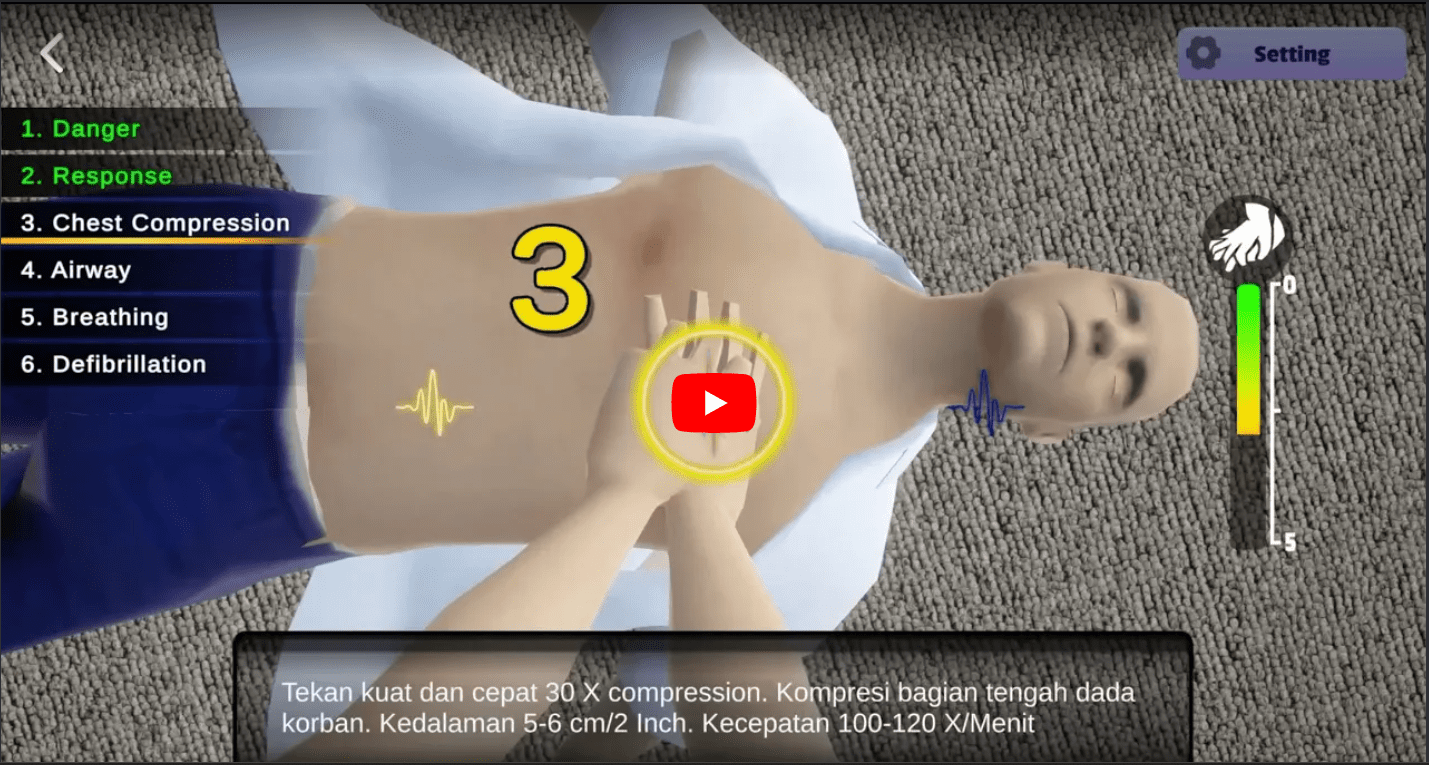
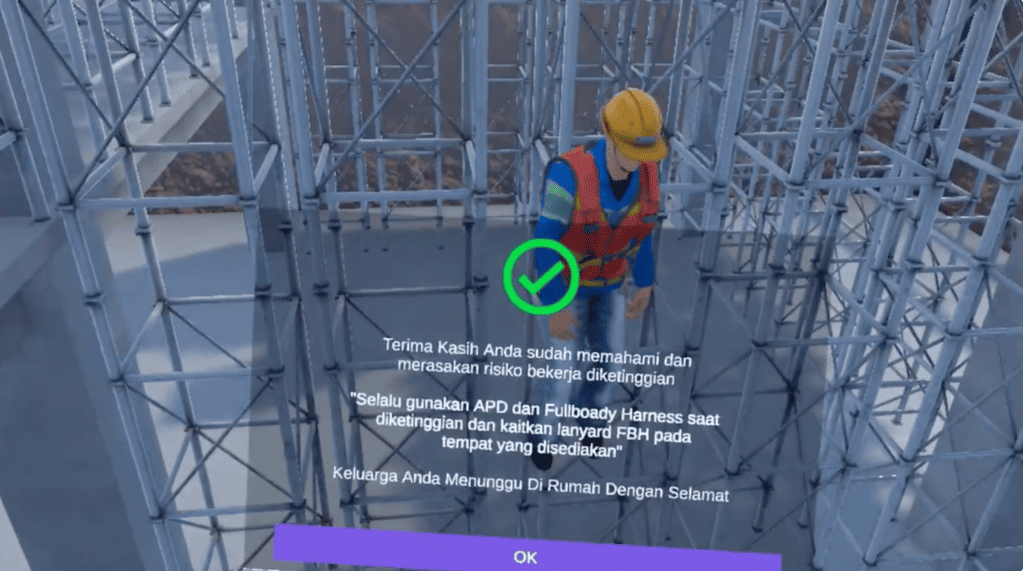
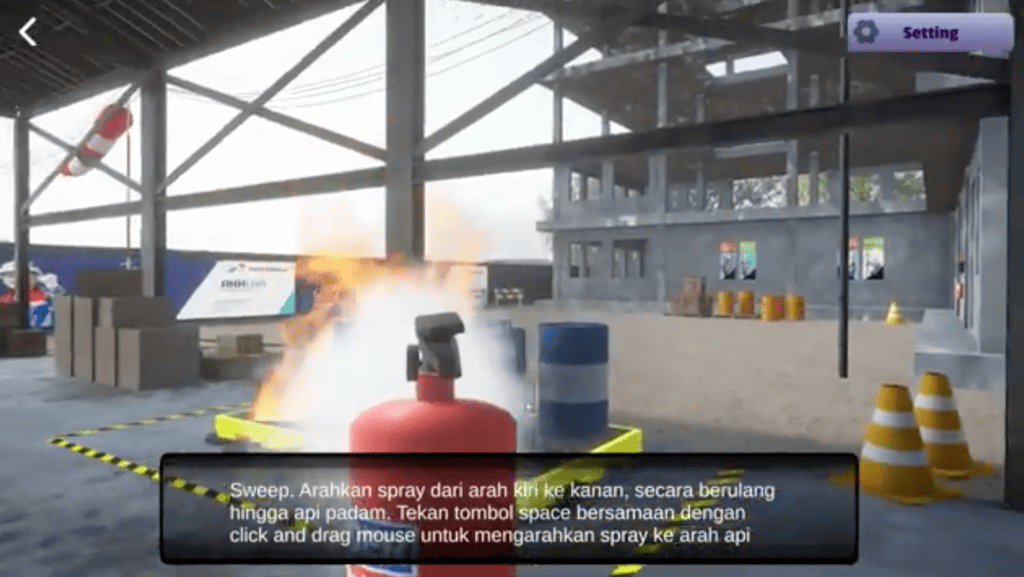
Hardware runs on standalone headsets, currently in the IDR 7 to 25 million range per unit depending on configuration. Content is licensed annually, per-seat or per-site. The same hardware extends across the broader VGLANT K3 catalog, including fire safety, work at height, hazardous material response, and first aid.
For confined space module specifications, pilot scoping, or rollout planning for a multi-site operation, contact enquiry@vglant.com or +62 818 0755 5538.