

In the competitive industrial landscape, Health, Safety, and Environment (HSE) training often faces a perception challenge. On one hand, it is an absolute regulatory mandate; on the other, financial management often views it merely as an “expenditure post” that erodes budget efficiency without an immediate ROI.
Conventional methods harbor hidden inefficiencies. The costs of refilling fire extinguishers, logistics, permitting, and the lost productivity of employees create an inefficient cost structure.
The arrival of Fire Safety VR Training technology from VGLANT changes this paradigm. Safety training is no longer just a budgetary obligation, but a strategic asset investment. Here is the analysis:
1. Budget Restructuring: From Variable to Fixed
The financial argument for VR is compelling. Traditional training is based on Variable Costs; every session requires consumables and recovery costs.
VGLANT’s solution shifts this to an initial investment model (Fixed Cost) with near-zero marginal operational costs. Once the system is installed, you can train 1,000 employees without additional costs for extinguishing agents. This represents significant long-term OpEx (Operational Expenditure) optimization.
2. Building “Muscle Memory” Under Pressure
Reading SOP manuals will not save lives when panic strikes. In real situations, humans act based on reflexes.
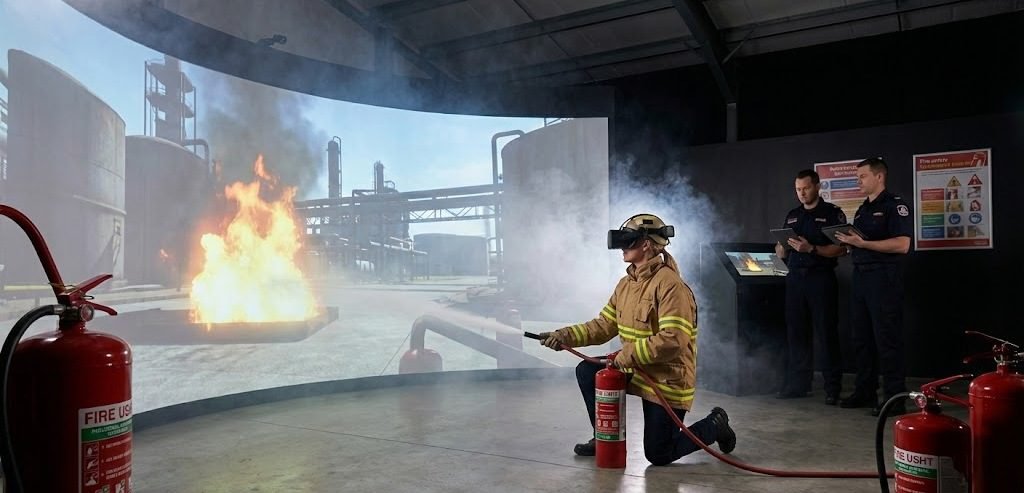
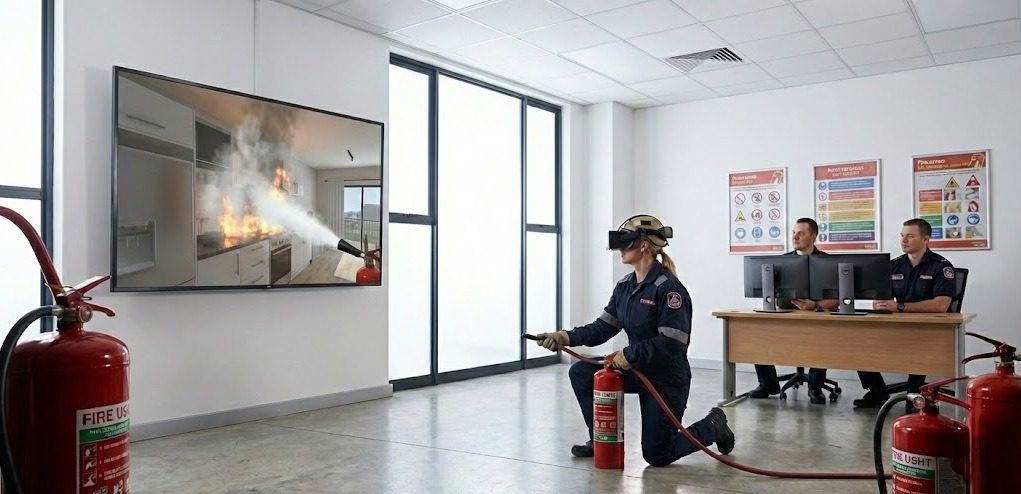
VGLANT VR simulations implant muscle memory. Participants must physically perform the P.A.S.S. (Pull, Aim, Squeeze, Sweep) procedure in the virtual world. VR can also simulate catastrophic scenarios—such as gas pipe explosions—that are impossible to train for in the real world, creating “battle-tested” mental readiness within a 100% safe environment.
3. Data-Driven Competency Validation
The fatal flaw of manual training is subjectivity. “I think he understands” is not a valid metric for safety audits.
VGLANT technology brings scientific objectivity. The system records telemetry for every action: reaction speed, angle accuracy, and the correctness of canister selection. Management receives clear analytical reports on who is competent and who needs retraining, closing the risk gap of human error.
4. Supporting Sustainability (ESG)
In the era of Environmental, Social, and Governance (ESG) compliance, burning fuel and releasing chemical residues for training is difficult to justify from a business ethics standpoint.
VR training is a green solution. No black smoke, no chemical residue. Adopting VR is concrete proof of the company’s commitment to environmental sustainability and clean innovation.
Conclusion:
Leave Obsolete Methods Behind Clinging to conventional methods in the digital age is a step backward. With VGLANT, companies gain budget efficiency, regulatory compliance, and peace of mind knowing that valuable assets—especially employee lives—are protected by the best readiness standards.
Contact Us
Ready to Transform Your Safety Standards?
Contact the VGLANT team for a consultation and demonstration of integrating VR technology into your HSE ecosystem.
Email: enquiry@vglant.com
Call / WhatsApp: +62 812 9696 7887
Website: https://www.vglant.com/
https://vglant.xyz/