

In technology development, there is often a gap between what developers think is cool, and what users actually need in the field.
Over the last year, the Vglant technical team spent hundreds of hours sitting down with HSE Managers, firefighters, and corporate trainers. We listened to their frustrations with generic VR simulators on the market: “The smoke doesn’t feel real,” or “Setting up the controllers takes too long.”
We took notes. We went back to the drawing board.
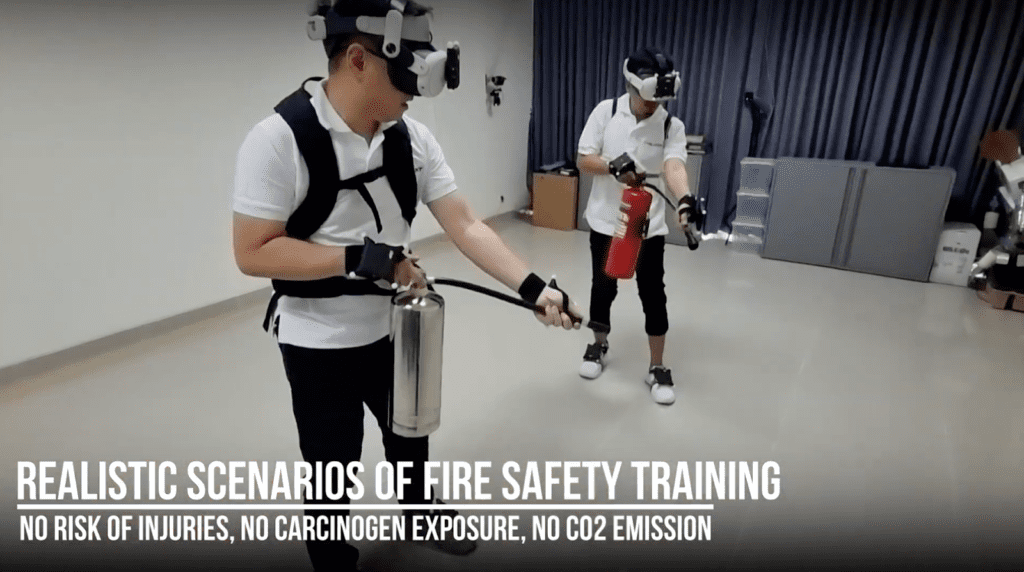
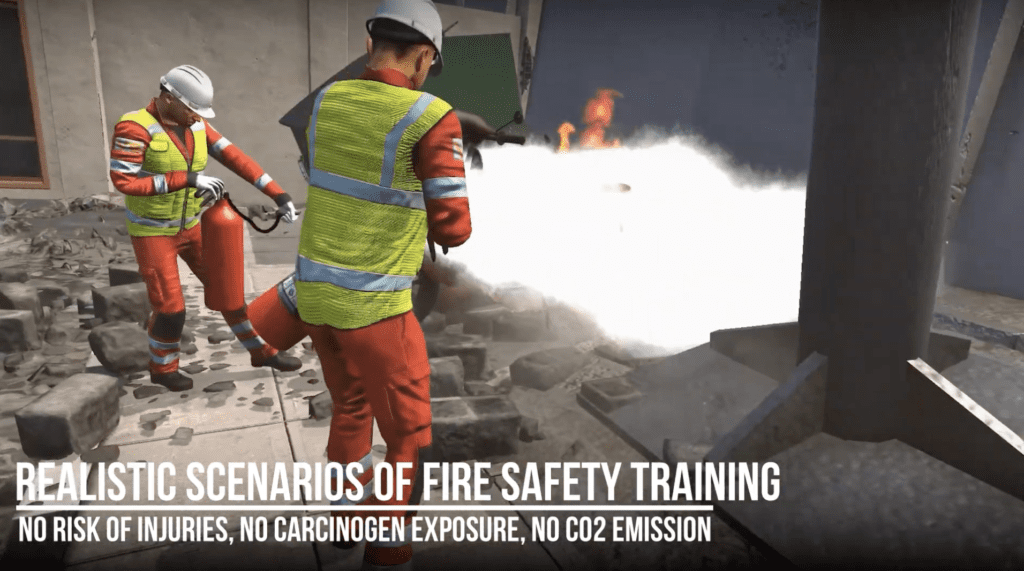
The result is an evolution. Here are 5 specific updates to the Vglant Fire Safety module driven directly by your requests.
1. Volumetric Smoke Physics (Deleting the “Gray Fog”)
Client Feedback: “In the old simulator, the smoke was just a transparent gray screen. My trainees could walk upright through it without fear. That teaches bad habits.”
The Vglant Update: We re-engineered our particle engine. The smoke in Vglant is now Volumetric and Layered.
Smoke accumulates at the ceiling (ceiling jet), banks down slowly, and darkens realistically. If the trainee does not physically crouch (duck and crawl) below the thermal layer, their visibility drops to zero. This forces the correct survival instinct, rather than just relying on verbal instructions.
2. Realistic Agent Duration
Client Feedback: “Trainees are spraying the fire for 2 minutes straight. In the real world, a 3kg extinguisher runs out in 12 seconds. This gives them a false sense of security.”
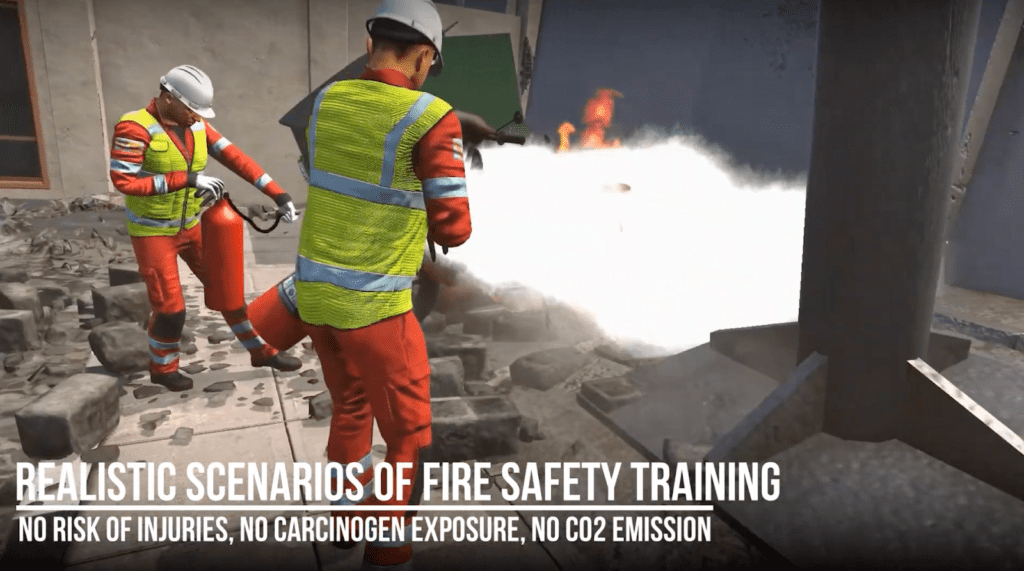
The Vglant Update: We introduced Resource Management. The virtual extinguisher tank now has physics-accurate capacity (based on weight and type). If a trainee wastes the spray by feathering the handle or aiming aimlessly, the tank will empty before the fire is out. This teaches the efficiency and urgency of the P.A.S.S. technique (Pull, Aim, Squeeze, Sweep).
3. “Zero-Friction” Mode (Kiosk Mode)
Client Feedback: “I need 10 minutes just to explain how to use the controllers to a 50-year-old warehouse worker. We are running out of training time.”
The Vglant Update: We simplified the UX into Kiosk Mode. No complex login menus. No long calibration. The trainee puts on the headset, and within 5 seconds, they are standing in front of the fire. We also simplified controller interaction: one button to grab, one button to spray. The focus of the drill is fighting the fire, not learning how to play a video game.
4. Adaptive Fire Behavior (Not Just a Loop)
Client Feedback: “The fire always shrinks the same way, no matter where I spray it.”
The Vglant Update: We embedded a Fluid Dynamics Algorithm. The virtual fire now reacts to the Impact Point of the extinguishing agent.
- Spray the top of the flames? The fire won’t go out (and might grow).
- Spray the base of the fire with a sweeping motion? The fire will retreat realistically. If the trainee stops spraying before the fire is completely extinguished, we simulate re-ignition, teaching them to always be vigilant and back away slowly.
5. Post-Action “Heatmap” Telemetry
Client Feedback: “I know they failed to put out the fire, but I don’t know WHY. Did they aim wrong? Or were they too close?”
The Vglant Update: We overhauled the results screen. Instead of just “FAIL,” we display an Aim Heatmap.
Instructors can visualize the trainee’s spray trail. “See this red graph? You spent 80% of the tank spraying the wall above the fire, not the source.” This visual data makes the debriefing session objective and educational.
Conclusion: Technology that Listens
Vglant doesn’t build simulators for tech expos; we build them to save your assets and lives. Every line of code we write aims to close the gap between simulation and reality.
Thank you for challenging us to be better. This is the result.