

Factory fire incidents in Indonesia don’t usually start from anything dramatic. They start from a welding spark that lands on a pallet nobody noticed. A short in a control panel that’s been overdue for inspection for six months. A solvent rag that wasn’t disposed of properly at end of shift. By the time the alarm goes off, the question is no longer how to prevent the fire — it’s whether the people on the floor know what to do in the next two minutes.
That two-minute window is where factory fire training either pays off or doesn’t. This article looks at how VR-based fire safety training fits into Indonesian factory operations, what scenarios it can drill that conventional training struggles with, and where it sits within the K3 framework set by Permenaker No. 4 Tahun 1980 and Kepmenaker No. 186 Tahun 1999.
Why factory fire training is different from office or warehouse training
A factory has hazards that an office doesn’t. Hot work happens daily — cutting, welding, grinding. Electrical loads are high and panels are everywhere. Solvents, lubricants, paints, and fuels are stored and handled throughout the production cycle. Combustible dust accumulates on overhead beams in textile mills, food processing plants, and any operation that handles powders or fibers. Lithium-ion batteries sit in WIP inventory at electronics assembly sites. Conveyor belts generate friction heat that nobody checks.
A factory also has shift patterns. Three shifts on a 24-hour line. Crews that don’t overlap. A fire at 03:00 on a Sunday shift is responded to by a different crew than the one that drilled with the K3 officer on Friday afternoon. Training that only reaches the day shift doesn’t actually cover the operation.
And factory headcount is large. A medium plant runs 300 to 800 workers across shifts. A large one runs into the thousands. Getting every person through an evacuation drill takes coordination that pulls people off the line. The cost of taking 400 workers off production for a 2-hour drill is not trivial. Plant managers know this. K3 officers know this. The result is that real drilling frequency lands well below what’s actually needed for skill retention.
VR addresses this constraint specifically — not by replacing the full-scale annual drill, but by making practice between drills feasible at the individual and small-team level.
Regulatory context for factory fire training in Indonesia
Three regulations form the operational frame.
Permenaker No. 4 Tahun 1980 covers APAR. Placement intervals, inspection schedule, color coding, agent compatibility with fire class. Personnel are required to know how to operate the extinguishers in their work area.
Kepmenaker No. 186 Tahun 1999 covers the tier structure for fire response teams. For a factory above a certain risk threshold, the property needs trained personnel at Class D level (peran kebakaran — baseline response across the floor), Class C level (regu penanggulangan kebakaran — the dedicated fire team), Class B (coordinator), and Class A (ahli K3 spesialis penanggulangan kebakaran). The number depends on plant size and risk classification.
Permenaker No. 5 Tahun 2018 (K3 Lingkungan Kerja) covers workplace environment, including fire prevention and emergency response procedures.
Sectoral overlays apply for specific industries — chemical (B3 handling), oil and gas (Migas regulations), mining (ESDM), food and beverage (BPOM intersections with sanitation), and electronics. SNI standards cover the technical specifications for alarm systems, sprinklers, and detection.
None of these regulations specify the training delivery method. They specify the competencies that must exist and the certification path for the response team. This is where VR has room to operate — as a tool for skill maintenance between certifications, not as a replacement for certification itself.
Factory-specific scenarios that work well in VR
The scenarios most worth running in VR are the ones that combine procedural complexity, time pressure, and consequence — the ones that physical drills don’t replicate well.
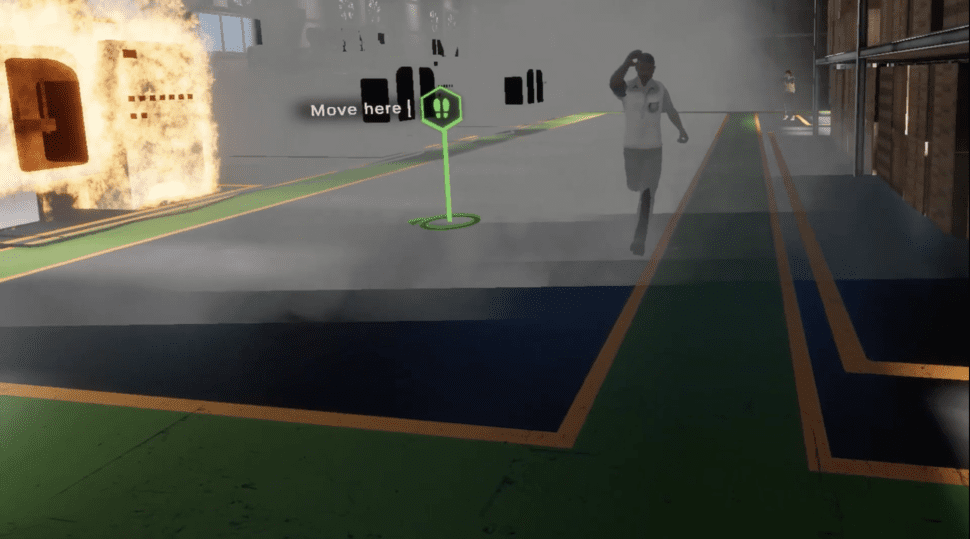
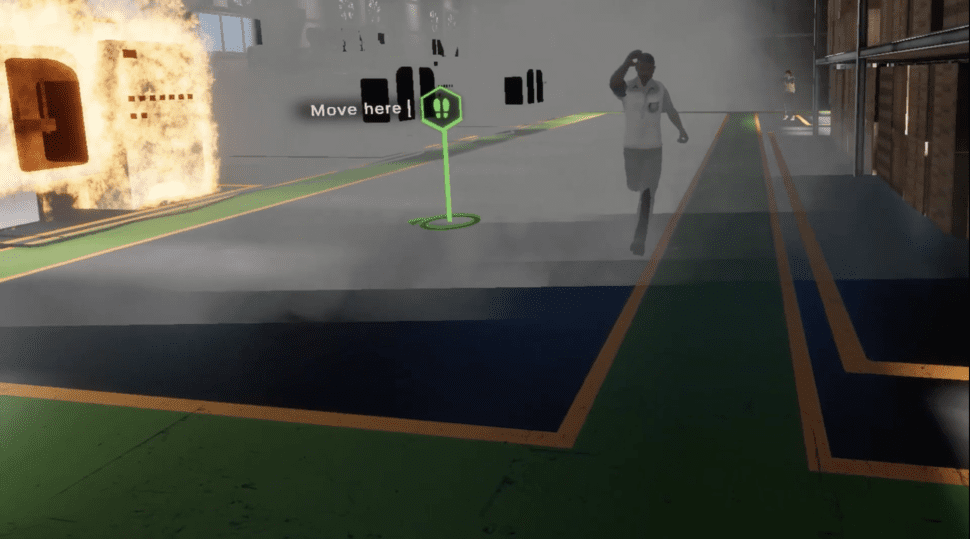
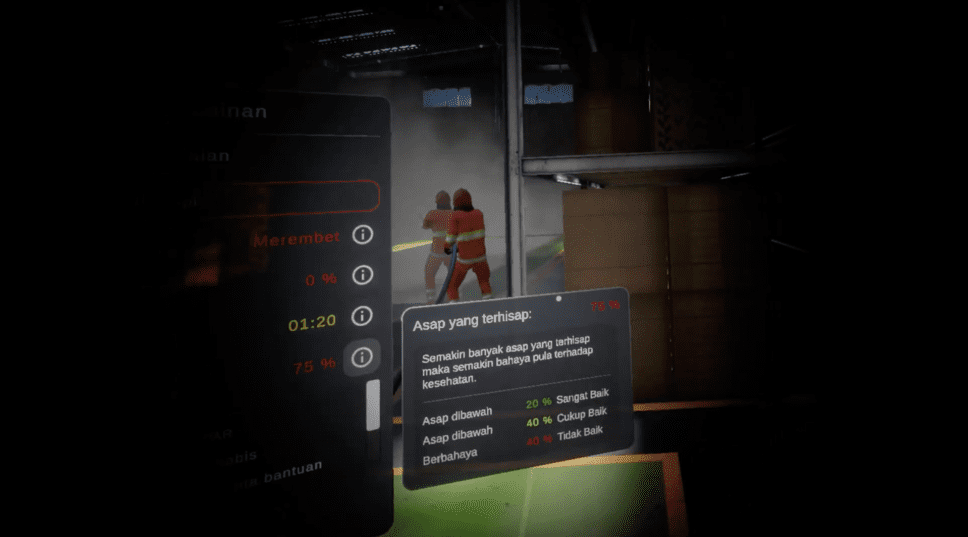
Hot work fire response. A welder on the mezzanine notices that sparks have ignited a stack of cardboard below the work area. The fire watch was supposed to be present and isn’t. What’s the correct sequence? Stop hot work, alert the operator below, use the nearest extinguisher (Class A or ABC), assess whether the fire is past the early stage and evacuation is needed. The scenario can vary the fire size to drill the fight-or-evacuate decision.
Electrical panel fire. A motor control center starts smoking. The reflex of using water is wrong (Class C requires CO2 or dry chemical). The reflex of opening the panel to investigate is wrong (introduces oxygen, risks arc flash). The correct sequence is to isolate the panel at the upstream breaker if possible, evacuate the immediate area, use the right extinguisher, and call for response. VR drills the decision sequence and the wrong-action consequences without anyone actually working on a live panel.
Combustible dust scenarios. Textile mills, flour mills, sugar refineries, and any operation handling fine particulates. The risk is not the open fire — it’s the secondary explosion when accumulated dust on overhead surfaces is suspended by the initial blast. The scenario can drill what to look for (visible dust accumulation, recent housekeeping failures, hot surfaces near dust paths) and how to respond when a primary ignition is detected before the secondary event.
Solvent and flammable liquid handling. A drum of solvent ignites near the dispensing area. Foam or dry chemical, not water. Containment versus suppression. The scenario can include the moment when the operator’s first instinct is to grab a water hose, and the correction.
Lithium-ion battery fires. Common in electronics assembly, e-bike manufacturing, and any warehouse storing electronics or consumer electronics inventory. These fires behave differently from conventional fires — thermal runaway, re-ignition risk, water is partially effective but quantities required are high. VR can drill the recognition (specific visual cues, characteristic smoke), the response (isolation, large-volume water cooling, evacuation distance), and the limits of standard extinguishers.
Conveyor belt fire. Friction heat from a jammed roller ignites the belt. The fire spreads along the belt path. The scenario drills the sequence: stop the conveyor at the nearest e-stop, isolate electrical, attack the fire from upstream of the spread direction.
Production line evacuation. A fire in one bay requires evacuating that bay and adjacent ones. Production needs to be shut down safely (some processes can’t just stop — molten material, chemical reactions, heated equipment). The scenario drills the production shutdown sequence in parallel with the evacuation, since both have to happen.
Coordination with arriving Damkar. What the K3 officer needs to be ready to communicate: location of origin, status of personnel, location of utility shutoffs, presence of hazardous materials in the affected area, status of sprinkler system. Less glamorous than firefighting, but it’s the bottleneck in most real factory incidents.
How shift-based rollout actually works
The constraint that defines factory training is shift coverage. The deployment pattern that works:
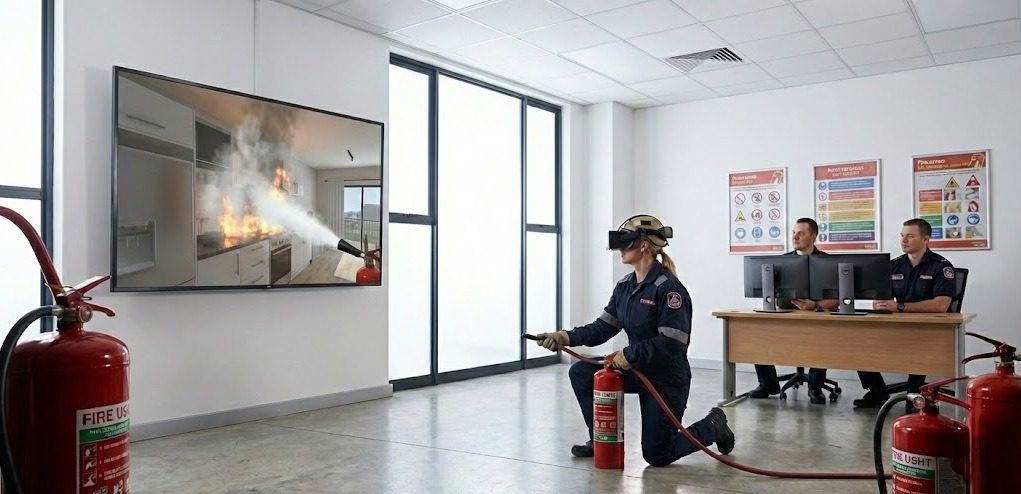
One portable VR case per plant, kept in a fixed training room or a dedicated corner of the K3 office. The case includes a small number of standalone headsets, a charging dock, and the scenario library. Setup per session is around 5 minutes. A 12 to 15 minute scenario plus a 5-minute debrief fits inside a normal break window.
Sessions are run by shift, by area, by role. Welders go through hot work scenarios. Electrical maintenance goes through panel scenarios. Production line operators go through the line-specific evacuation scenarios for their bay. Forklift operators go through the warehouse scenarios. K3 officers go through coordination and Damkar handoff.
The K3 team rotates through the floor across shifts. A trainer-led briefing followed by individual VR sessions for each worker on the shift. Total time for a shift of 50 workers is around 4 to 6 hours, including setup and rotation. This is significantly less disruptive than pulling the same 50 workers into a half-day classroom session, and considerably more effective per training minute.
Monthly or quarterly cadence becomes feasible. So does just-in-time refresher before a high-risk operation — a hot work permit being issued can trigger a 12-minute VR refresher for the welder before they start.
Where physical drilling still belongs
Worth being clear about the limits.
The annual full-plant evacuation drill is still required and still useful. The full-scale drill is the only thing that actually tests the alarm audibility at the far end of the production hall, the assembly point capacity, the headcount procedure at scale, and the coordination between the K3 officer, the shift supervisors, and the line leaders. VR doesn’t cover that.
Live APAR practice with a real extinguisher and a controlled propane tray is still useful, particularly for the dedicated fire response team (Class C and above under Kepmenaker 186/1999). The physical sensation of the cylinder weight, the pin release, and the discharge angle is something controllers don’t fully replicate. Hybrid setups with tracked physical extinguisher props are closer but don’t fully replace it.
Initial certification still comes from BNSP-recognized providers and licensed K3 instructors. VR is not an accredited certification path.
Drills for response team Class A and Class B personnel — the people who lead incident response — still need tabletop exercises and live coordination drills with the team intact. Different cognitive layer, different participants.
VR fits between these. More frequent than the annual drill. Wider scenario variety than live APAR practice. Better cognitive realism than tabletop. Each part of the program covers what it covers well, and the mistake to avoid is treating any single part as the complete program.
Measuring program effectiveness in a factory context
For a plant manager and K3 officer, the data that matters from a VR-based training program isn’t abstract.
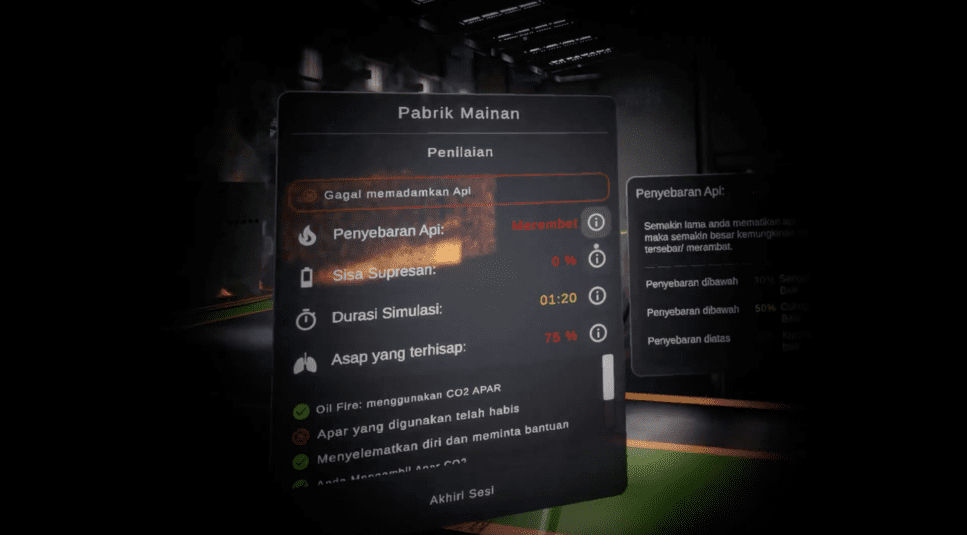
Per-trainee scenario completion across the headcount, with role-relevant scenarios linked to each position. The system tracks who has run which scenarios, when, and how they performed.
Time-to-first-action averages tracked over quarters. If the average response time on hot work fire scenarios drops from 24 seconds to 11 seconds across the welding team after three rounds of practice, that’s a measurable competency gain that audits can see.
Scenario-specific failure rates. If 35% of electrical maintenance staff are choosing water instead of CO2 on Class C scenarios, that’s a targeted gap to fix before it becomes an incident.
Coverage by shift. The system can show how many people from each shift have completed each scenario in the last training cycle. Gaps in shift coverage become visible rather than assumed.
Audit-ready records, exportable per trainee, per scenario, per date. K3 inspectors during pemeriksaan increasingly ask for demonstrable competency records, not just attendance lists.
VGLANT factory and manufacturing modules
VGLANT, built by PT Virtu Digital Kusuma, includes scenarios specifically developed for industrial and manufacturing contexts. The catalog covers hot work fire response, electrical panel fires, combustible dust recognition, flammable liquid handling, lithium-ion battery scenarios, conveyor and production line fires, multi-bay evacuation, and Damkar coordination. UI defaults to Bahasa Indonesia with English available, useful for plants with mixed local and expat management.
Hardware runs on standalone headsets in the IDR 7 to 25 million range per unit depending on configuration. Content is licensed per-seat or per-site annually. The same hardware extends across the broader VGLANT K3 catalog: CPR and first aid, hazardous material response, work at height, confined space — modules that most factories need alongside the fire training.
For pilot scoping at a single plant or rollout planning across a multi-site operation, contact enquiry@vglant.com or +62 818 0755 5538.