


In the architecture of contemporary risk management, a fundamental discrepancy exists between safety protocols documented on paper and the reality of execution in the field. Many industrial organizations remain trapped in an illusion of readiness, where administrative compliance—such as the mere existence of Standard Operating Procedures (SOPs)—is equated with operational competence.
However, incident data reveals a concerning phenomenon: when an actual crisis manifests, whether in the form of critical infrastructure failure or a catastrophic natural event, personnel readiness often collapses. The primary driver of this failure is not a lack of theoretical knowledge, but rather the inability of cognitive functions to operate effectively under extreme pressure.
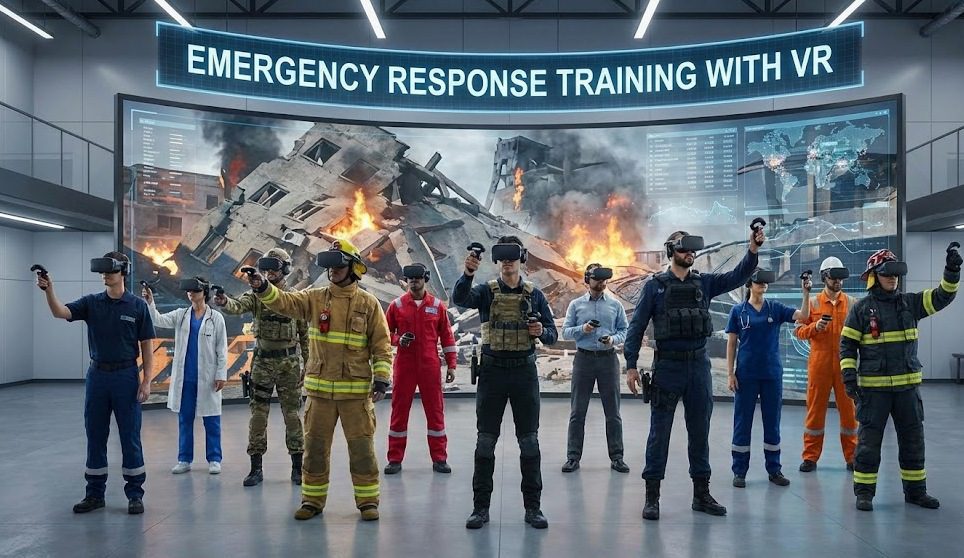
The integration of Emergency Response Training based on Virtual Reality (VR), specifically through the simulation ecosystem developed by VGLANT, offers a re-engineering of occupational safety pedagogy. This technology transforms training from passive information transfer into competence validation based on immersive experience.
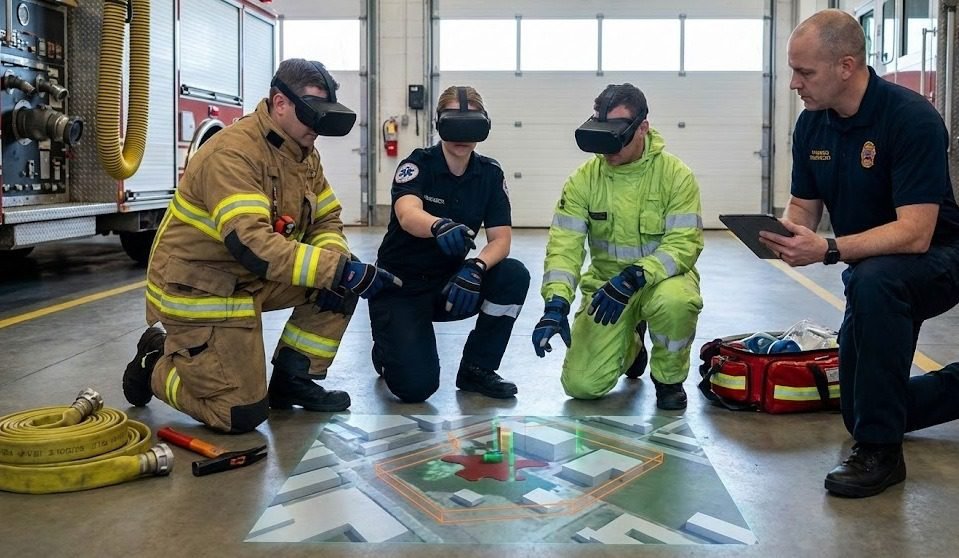
Below is a comprehensive analysis of the five strategic mechanisms by which VR radically elevates crisis preparedness standards.
1. Stress Inoculation Against the “Amygdala Hijack”
Neurobiologically, crisis situations trigger a fight-or-flight response that often results in an “amygdala hijack.” In this state, the prefrontal cortex—the center for logic and decision-making—suffers inhibition, causing personnel to experience response paralysis (freezing). Conventional classroom training is structurally incapable of replicating these stress triggers.
The VGLANT simulation platform is engineered to provide stress inoculation. By delivering intense audio-visual stimuli—such as deafening alarms, limited visibility due to smoke, and temporal urgency—the system trains the brain to desensitize panic responses. The result is a workforce capable of maintaining operational clarity and executing mitigation protocols with precision amidst chaos.
2. Eliminating the Risk Paradox in Extreme Scenarios
There is an inherent paradox in traditional safety training: to train responses to catastrophic hazards, instructors must introduce those hazards, which is logistically and ethically impossible. Consequently, high-impact, low-probability scenarios (such as reactor explosions or lethal gas leaks) are rarely practiced realistically.
VR facilitates a “Zero-Risk, High-Fidelity” environment. Personnel can be exposed to the fatal consequences of decision-making errors within the virtual world without any physical risk. This experiential learning methodology allows organizations to test the limits of their teams in worst-case scenarios, ensuring that failure occurs only within the simulator, never in the actual facility.
3. Accelerating Procedural Retention Through Kinesthetic Memory
Emergency preparedness is not merely an intellectual activity; it is a psychomotor competence. Speed and accuracy in the use of emergency equipment depend heavily on muscle memory. The low frequency of conventional drills (often annual) is insufficient to establish persistent reflexes.
The implementation of VR enables frictionless repetition. Once digital infrastructure is deployed, the marginal cost per training session becomes negligible. This allows personnel to repeat critical procedures—such as medical evacuation or system shutdowns—hundreds of times until these actions are internalized as automatic reflexes requiring no slow, conscious thought.
4. Evaluation Objectivity Based on Performance Telemetry
Evaluations in manual drills are often qualitative and prone to the subjective bias of the observer. Success metrics are frequently reduced to mere task completion without regard for process efficiency.
Digitizing training through VGLANT introduces a standard of data-driven accountability. The system records performance telemetry with high granularity, covering reaction latency, procedural sequence accuracy, and even visual attention focus (eye-tracking). This quantitative data provides management with an accurate and auditable risk profile for every individual, enabling precise training interventions targeting specific weaknesses.
5. Homogenization of Competence Standards Across Operations
For corporate entities with geographically decentralized operations, the variability of training quality across locations represents a latent risk. Disparities in local instructor competence can lead to inconsistencies in the application of corporate safety standards.
VR simulators function as a centralized platform for training materials. Identical simulation scenarios and assessment parameters are digitally distributed to all operational units. This guarantees the homogenization of competence, where personnel at headquarters and remote sites are evaluated using the same rigorous standards, ensuring uniform compliance with the company’s crisis management policies.
Conclusion: A Strategic Imperative for Business Resilience
The transition toward virtual simulation-based training is not merely a modernization of learning instruments; it is a strategic move to strengthen operational resilience. In an industrial era characterized by volatility, reliance on obsolete conventional training methods is a liability that cannot be tolerated.
Investing in VGLANT technology is a manifestation of a corporate commitment to mitigating risk at the most crucial point: human capital readiness.
Technical Solution Reference: https://vglant.xyz/
Contact Us
For an in-depth discussion regarding the integration of VR-based Emergency Response Training into your corporate risk management architecture, please contact our expert team.
Email: enquiry@vglant.com
Call / WhatsApp: +62 812 9696 7887Website: https://www.vglant.com/