

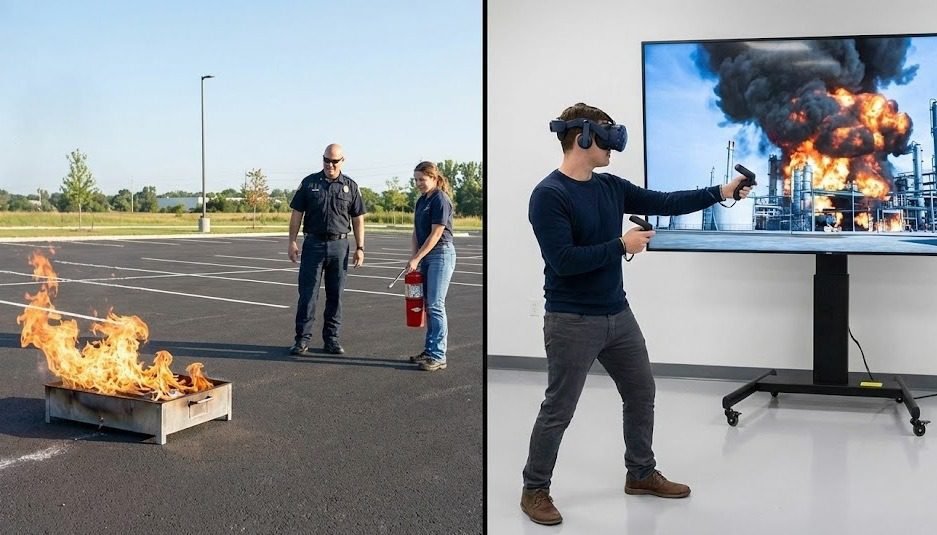
There exists a fundamental disconnect in how modern industry approaches safety training. On one hand, enterprises operate in environments of extreme complexity—offshore oil rigs, chemical manufacturing plants, or high-voltage facilities. On the other hand, the training methodologies used to mitigate these risks often remain stagnant, relying on conventional practices limited to extinguishing controlled fires in open parking lots.
This gap between training simulation and disaster reality creates a dangerous operational “blind spot.” When a real incident occurs, personnel readiness often collapses—not due to incompetence, but because they were never truly trained to face the intensity of a genuine catastrophe.
Digital transformation through Fire Safety VR Training—such as the solutions developed by VGLANT—is not merely about digitizing courseware. It is a re-engineering of human response mechanisms to danger.
Below is an in-depth analysis of the seven strategic implications of adopting VR within a modern safety ecosystem.
1. Eliminating the “Risk vs. Realism” Dilemma
The primary challenge for HSE (Health, Safety, and Environment) managers is providing a realistic experience without injuring participants. Conventional methods have physical limitations; you cannot simulate a gas pipe explosion or a fire in a confined space without introducing fatal risks. Consequently, drills often feel artificial and “safe.”
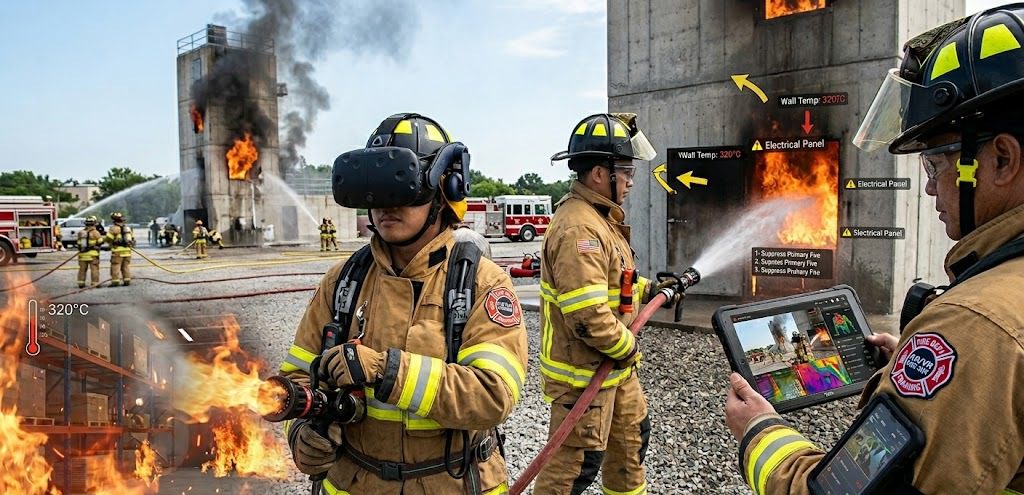
VR resolves this dilemma absolutely. The technology allows for the simulation of “worst-case” scenarios with visually intimidating fire and smoke that exert psychological pressure, yet remain physically sterile. Personnel can experience the urgency of an emergency, practicing decision-making under duress while remaining in a 100% safe zone.
2. Muscle Memory: Beyond Cognitive Understanding
In panic situations, human cognitive function tends to degrade drastically. Employees often forget what they read in SOP manuals. What remains in those critical moments is instinct and muscle memory.
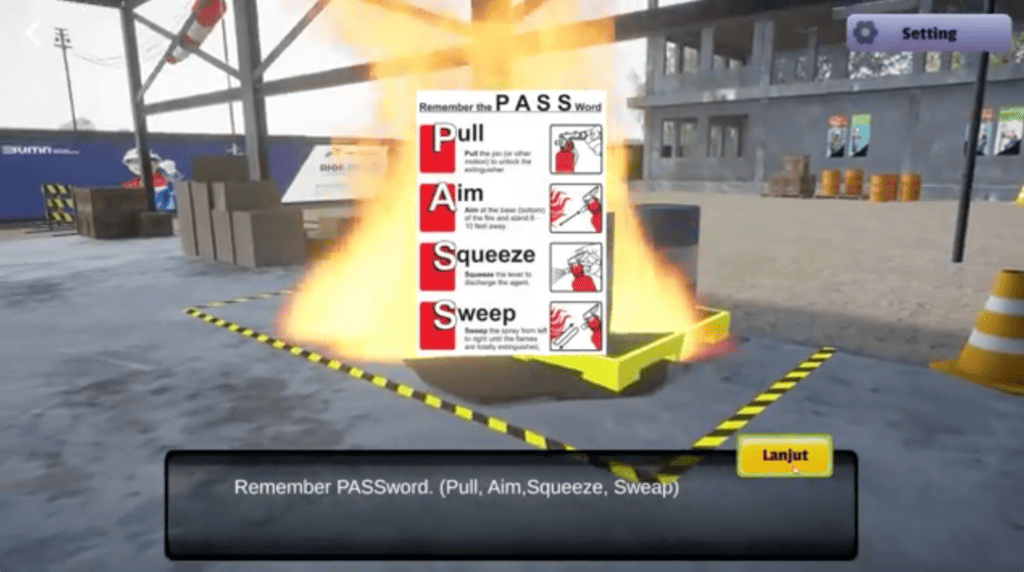
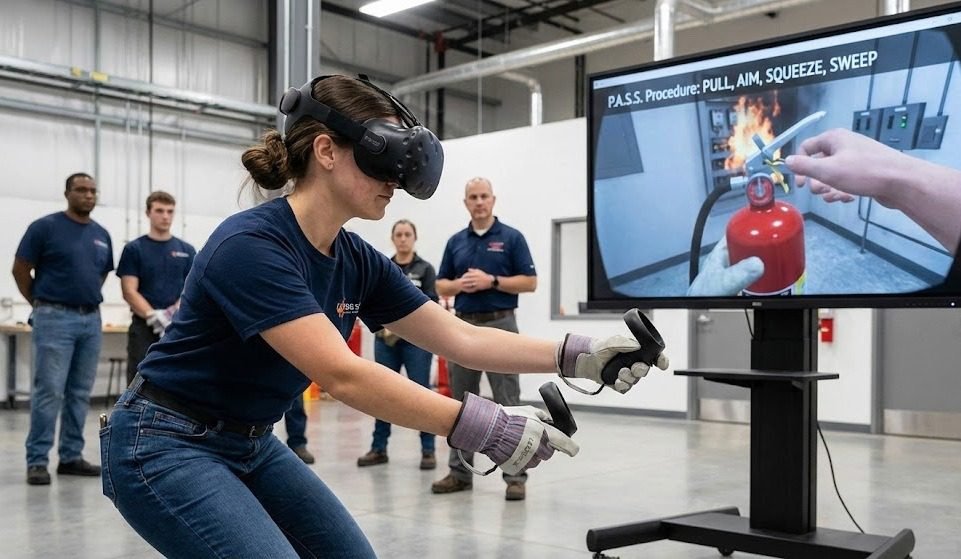
The VGLANT simulator system goes beyond visualization; it demands precise kinetic interaction. Participants are forced to physically perform the P.A.S.S. (Pull, Aim, Squeeze, Sweep) procedure repeatedly.
- Pull: Physically pulling the virtual safety pin.
- Aim: Crouching and directing the nozzle at the base of the fire.
- Squeeze: Pressing the lever with correct timing.
- Sweep: Sweeping the area of the fire.
This motor repetition encodes the procedure into the body’s memory. The result is an automatic reflex that engages faster than conscious thought when facing real flames. You can view the technical details of this application here: Fire Extinguisher Training.
3. Structural Reduction in OpEx (Operational Expenditure)
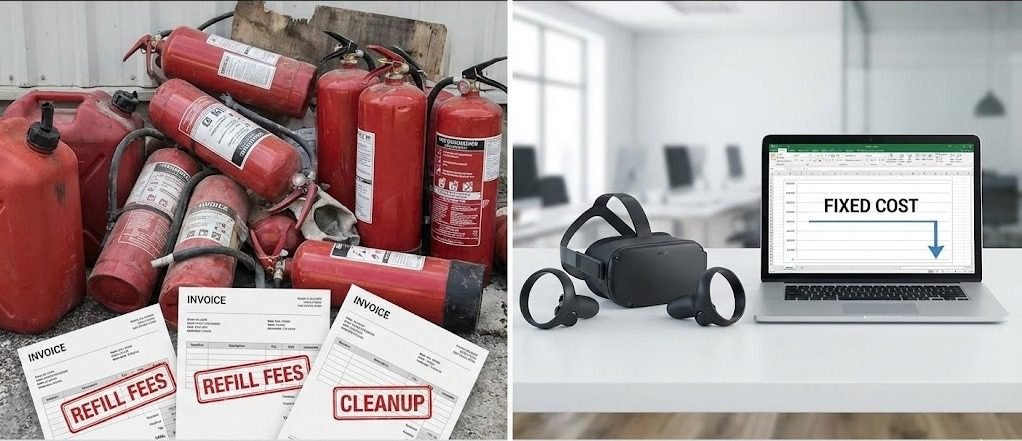
Fiscally, traditional training contains hidden inefficiencies. Logistics, permitting, fuel costs, and specifically the cost of refilling extinguishers post-training represent recurring expenses that drain operational budgets.
Adopting fire safety vr training shifts this cost structure from a Variable Cost model to a Fixed Cost model. Following the initial hardware investment, the cost per training session drops to near zero. There are no consumables wasted, no canisters to refill, and no cleanup costs. This scalability allows companies to train thousands of employees at a significantly lower cost per head compared to manual methods.
4. Telemetry-Based Objectivity
A fatal flaw in manual training is instructor subjectivity. “Pass/Fail” assessments are often based on visual observation, which is prone to bias. “He looks like he understands” is not a valid safety metric.
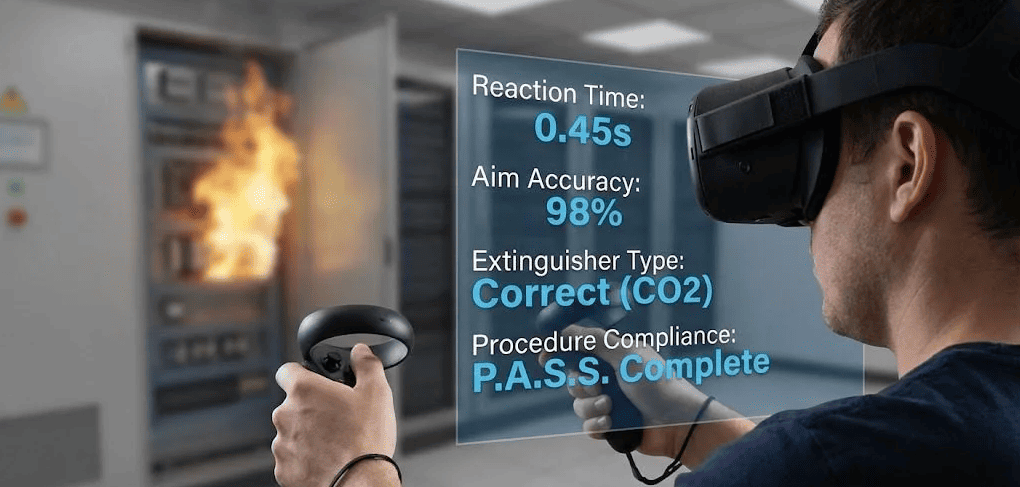
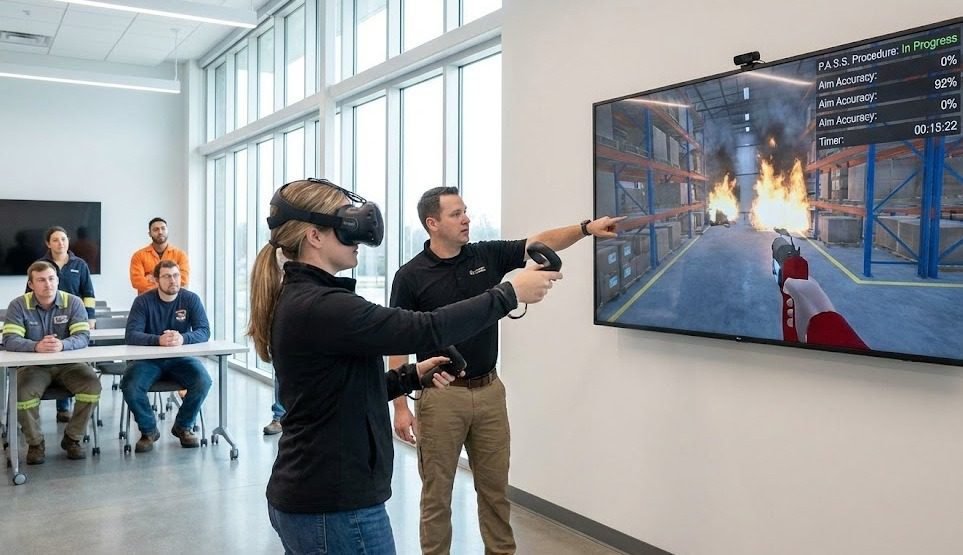
Digitization brings a new standard of accountability through data. VR systems record every millisecond of user interaction: reaction times, spray angle accuracy, and the correctness of the extinguisher selection. This telemetry provides an irrefutable competency profile, allowing management to identify skill gaps with precision before an incident occurs.
5. Cross-Classification Scenario Contextualization
Using water on an electrical panel fire (Class C) is a fatal error often born from a lack of varied training. Parking lot drills rarely replicate specific hazards like electrical short circuits in a server room or chemical spills in a laboratory.
The VGLANT platform facilitates dynamic simulation. In a single session, scenarios can switch instantly from a paper fire (Class A) to a flammable liquid fire (Class B) or an electrical hazard. This flexibility ensures personnel are not just generally proficient, but specifically competent in handling threats relevant to their actual work zones.
6. ESG Compliance: Towards “Zero-Emission Training”
In an era where sustainability is a corporate KPI, training practices that release chemical residues or combustion emissions are becoming difficult to justify. Traditional methods generate hazardous waste (B3) and air pollution that contradict Environmental, Social, and Governance (ESG) principles.
VR training offers a wireless, zero-emission solution. No chemical residue contaminates the soil; no black smoke is released into the atmosphere. It is a concrete step in aligning safety protocols with corporate sustainability commitments.
7. Retention Through “Immersive Engagement”
Andragogy (adult learning) studies indicate that passive methods, such as classroom lectures or watching safety videos, result in information retention rates below 20%. Employees often view HSE training as a tedious formality.
VR shifts this paradigm by positioning the employee as the central actor in an immersive simulation. The full engagement of visual, auditory, and kinetic senses creates a robust memory trace. Employees who have “experienced” a virtual fire possess a level of mental readiness far superior to those who have merely “heard” about how to extinguish one.
The Strategic Next Step
Investing in safety technology is not an expense; it is asset protection. In high-risk environments, training failure can lead to catastrophic loss, both financially and in human life.
Contact Us
VGLANT is ready to assist your organization in transitioning to a measurable, efficient, and impactful data-driven training methodology.
Email: enquiry@vglant.com
Call / WhatsApp: +62 812 9696 7887
Website: https://www.vglant.com/
https://vglant.xyz/