

In the discourse of contemporary industrial risk management, there is an urgent need to re-evaluate the effectiveness of conventional safety training methodologies. Historically, the paradigm of fire safety training has often been confined to administrative compliance, where certification of attendance is prioritized over the validation of factual competence.
Field reality, however, reveals a significant competency gap. When actual fire incidents occur, certified personnel frequently fail to execute safety protocols due to cognitive degradation under pressure.
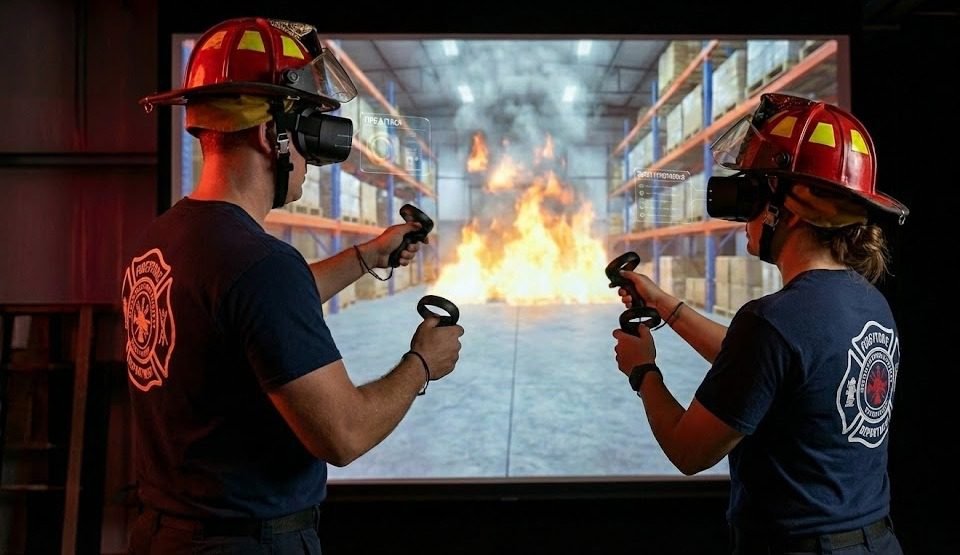
The integration of Fire Extinguisher VR Training technology, such as the ecosystem developed by VGLANT, offers a re-engineering of occupational safety pedagogy. This technology transforms training from a passive activity into an immersive, data-driven simulation.
Below is a comprehensive analysis of six strategic reasons why VR adoption is an imperative for modern emergency readiness.
1. Eliminating the Risk Paradox in Training
Conventional training methods face a fundamental constraint: to train personnel to handle danger, instructors must introduce danger. Live-fire drills carry inherent risks of physical injury, environmental pollution, and potential asset damage.
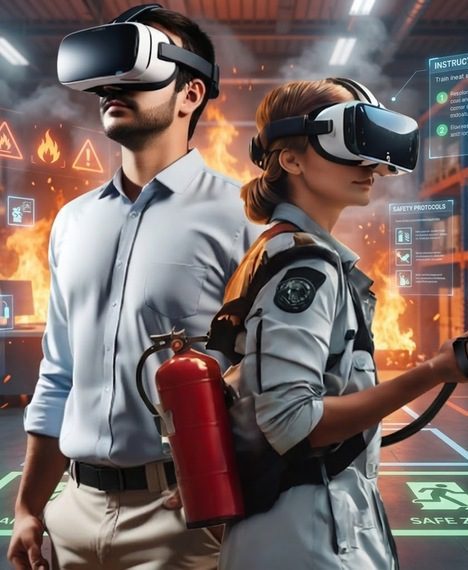
VR technology resolves this paradox by creating a “Zero-Risk High-Hazard” environment. Through digital simulation, personnel can be exposed to high-intensity fire scenarios—such as massive electrical failures or hazardous chemical spills—without physical consequences. This enables organizations to train responses for worst-case scenarios that are impossible to safely replicate in the real world.
2. Optimizing Operational Expenditure (OpEx) Efficiency
From a financial perspective, traditional training possesses a high, recurring variable cost structure. Cost components include agent refills, simulation fuel consumption, post-drill waste management, and inefficiencies due to prolonged production downtime.
Implementing VR simulators shifts the training cost structure to a fixed investment with a marginal cost approaching zero for each additional session. This scalability delivers significant Return on Investment (ROI), allowing thousands of personnel to be trained periodically without burdening the company’s operational cash flow.
3. Stress Inoculation and Psychological Conditioning
Theoretical understanding of the P.A.S.S. (Pull, Aim, Squeeze, Sweep) procedure is often inaccessible to the human brain during cognitive overload caused by panic. Static classroom training fails to replicate the psychological pressure of a real emergency.
The VGLANT system is designed to provide stress inoculation. By simulating sensory chaos—including visual impairment from smoke and auditory disruption from explosions—within a controlled environment, the system trains the participant’s brain to desensitize panic responses. The result is personnel capable of maintaining operational clarity and acting procedurally under extreme pressure.
4. Accelerating Muscle Memory Formation
Technical competence in using portable fire extinguishers relies heavily on muscle memory. The annual training frequency commonly applied in traditional methods is insufficient to establish robust motor reflexes.
VR facilitates frictionless repetition. An operator can perform the extinguishment procedure dozens of times in a single short session until reaching optimal motor proficiency. This intensive repetition ensures that safety actions become instinctive responses rather than mere cognitive recollections.
5. Competency Validation Based on Data Objectivity
Manual evaluation in conventional training is prone to subjective instructor bias and often lacks data granularity. Qualitative assessments like “pass/fail” do not provide deep insights into personnel readiness.
Digitizing training through VGLANT introduces a standard of telemetry-based accountability. The system records and analyzes micro-performance metrics, such as reaction time latency, spray angle precision, and agent selection accuracy according to fire classification. This quantitative data provides management with an accurate and auditable risk profile for every individual.
6. Standardizing Corporate Compliance Across Locations
For multinational conglomerates or companies with decentralized operations, the variability of training quality across locations represents a serious compliance risk. Disparities in local instructor competence can lead to inconsistencies in the application of safety standards.
VR platforms enable the centralization and standardization of training materials. Identical simulation scenarios and assessment parameters can be digitally distributed to all operational units, whether at headquarters or remote sites. This guarantees uniformity in safety competence and adherence to corporate policies throughout the organization.
Conclusion: A Strategic Imperative for Business Resilience
The transition toward simulation-based virtual training is not merely a technological modernization; it is a strategic move to strengthen operational resilience. In an industrial era fraught with uncertainty, relying on obsolete training methods is an unnecessary liability.
Investing in VGLANT technology is a manifestation of a corporate commitment to protecting its most valuable asset: human capital.
Technical Solution Reference: https://vglant.xyz/fire-extinguisher.html
Contact Us
For an in-depth discussion regarding the integration of Fire Extinguisher VR Training into your corporate risk management architecture, please contact our expert team.
Email: enquiry@vglant.com
Call / WhatsApp: +62 812 9696 7887
Website: https://www.vglant.com/